Ken, Ellen and Bei in China

Ken, Ellen and Bei spent a year in Lijiang, Yunnan teaching English. This is a place where we kept in touch with everyone while we were away. If you'd like to comment we'd love to hear from you on e-mail. Send to kdriese@uwyo.edu. You can view more photos on Flickr at http://www.flickr.com/photos/kdriese.

Name: Ken Driese
Location: Laramie, Wyoming, United States

Wednesday, January 10, 2007

Entering Xinjiang

Like a flash, six months have gone by and outside my window I see the snow of a Laramie winter instead of the clear blue sky of the dry season in Yunnan. Bummer! Instead of motivating to teach for two hours a day, I pack a lunch and head to my office for eight, a fact of life that I’m still not used to after our China year (will I ever be used to it again??). And instead of a half hour bike ride to work along with people toting butchered pigs and hauling baskets of vegetables, I walk to the gym at noon and ride the stationary bike while reading Newsweek. The transition has not been easy.

It gets harder to think back and remember what it was like to live in China, but this blog remains unfinished and we visited some incredible places in July 2006 – Xinjiang, Gansu, Jiangxi and finally Beijing, where we boarded a jet and emerged in the U.S. some 12 hours later to begin gaining weight. So I’ll post a few more entries to try to at least partly finish the year’s story. Probably I will mostly just add photographs from our travels with extended captions, but maybe a little commentary here and there.

We left Lijiang in late June, first giving away a small truckload of accumulated “stuff” (American consumerism is hard to shake) to a woman whose family runs a guest house in the little village of Yuhu, site of Joseph Rock’s former home at the base of Yulong Shuishan. In the pile to give away: pirated DVDs and a DVD player, mattresses, blankets, my industrial grade power converter (for charging my never-used rock climbing drill), kids books, kitchen wares, miscellaneous food, and our trusty “Beartrap” bicycles. To carry with us for the next month: a huge suitcase, a huge, heavy backpack and several smaller bags, all stuffed with things we either couldn’t mail or thought we might need. For the next month we would feel like pack animals, dragging this pile of luggage from plane to train to hotel and back again in the heat of a Chinese summer and stashing it whenever possible in “left luggage” rooms to be reclaimed after excursions. I always vow that on the NEXT trip I will travel light, but it never happens.

By the time we said goodbye to our friend Jacqueline, who rode with us to the airport, and boarded the plane to Kunming, we were too tired of packing and waiting for our last paychecks to be especially sentimental about leaving, though there were tearful goodbyes with our Naxi neighbors and Western friends and last looks towards Jade Dragon Snow Mountain.

In Kunming we boarded another plane for the long flight to Urumqi, capitol of the Xinjiang, China’s vast, westernmost province where the high mountains of the Tian Shan and the Himalaya cradle broad deserts that are the lowest and hottest places in China. The flight from Kunming took us across the edge of the Tibetan Plateau and the Qinghai Province and high empty landscapes extended off to the horizon, a temptation for future travels. The mountains just north of Qinghai lake looked especially tempting in their emptiness.

Urumqi, our initial destination, was far from empty and we deboarded into a new world from the one we had left in Yunnan. Xinjiang is dominated by the Uighur minority—Chinese Muslims—and though the Han are making a stout effort to overwhelm this population with immigration, entering Urumqi feels like leaving China for the Middle East. Men wear Muslim hats, women are often covered and minarets replace Chinese pagodas in piercing the skyline. And it isn’t just a feeling. Like Tibet, the Uyghurs have historically been more linked to Central Asia than to China, and many long for independence, much as Tibet has tried to remain separate. And uprising have been crushed by the Chinese with similar overwhelming force. Peter Hessler’s recent book “Oracle Bones” explores the Uyghur’s at least superficially and is an interesting introduction.

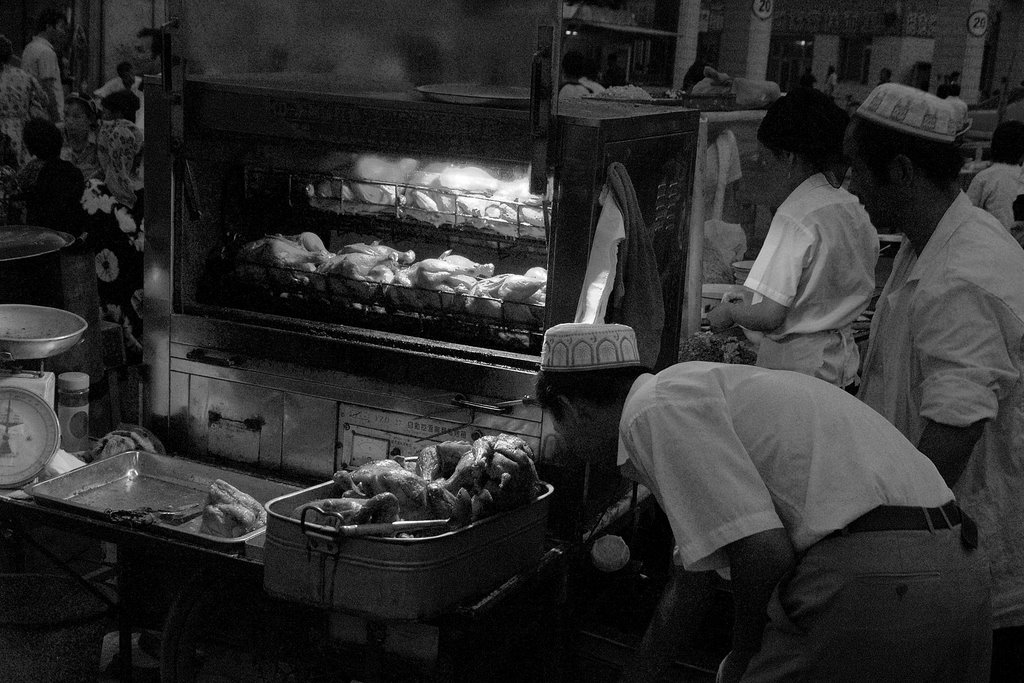
We spent just a couple of nights in Urumqi and a night in nearby Turfan (Turpan), an oasis in the nearby desert. Here are a few photos.
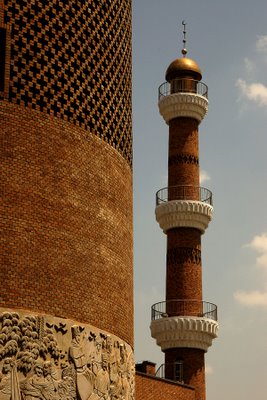


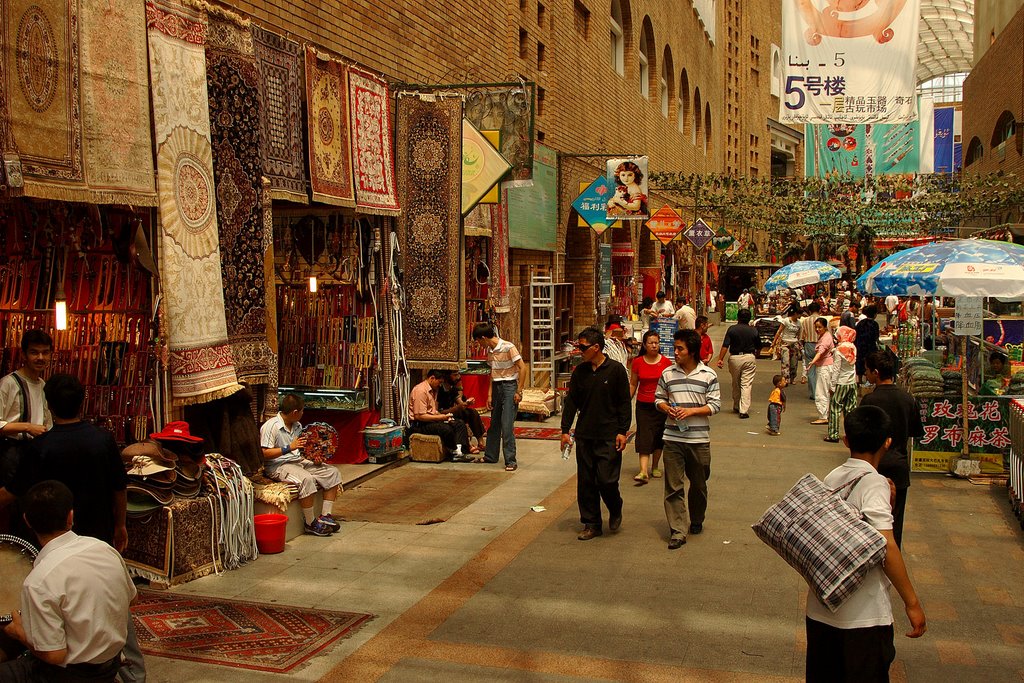
Minarets signal a major change in cultural heritage from the Naxi world of Lijiang to the Uighur Muslim world of Xinjiang and Urumqi. These two were at the "Da Bazaar" or "Big Market" in Urumqi.
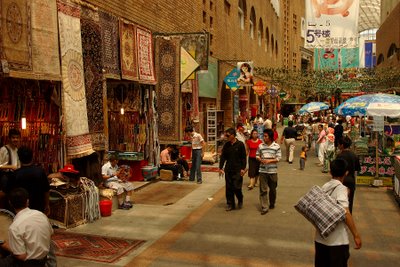

The Da Bazaar was also a new world of things for sale. No more Dongba script!
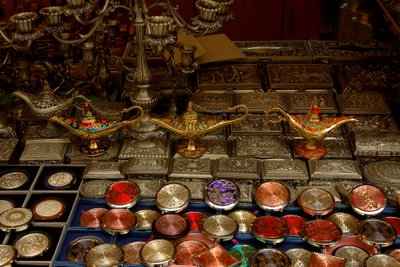

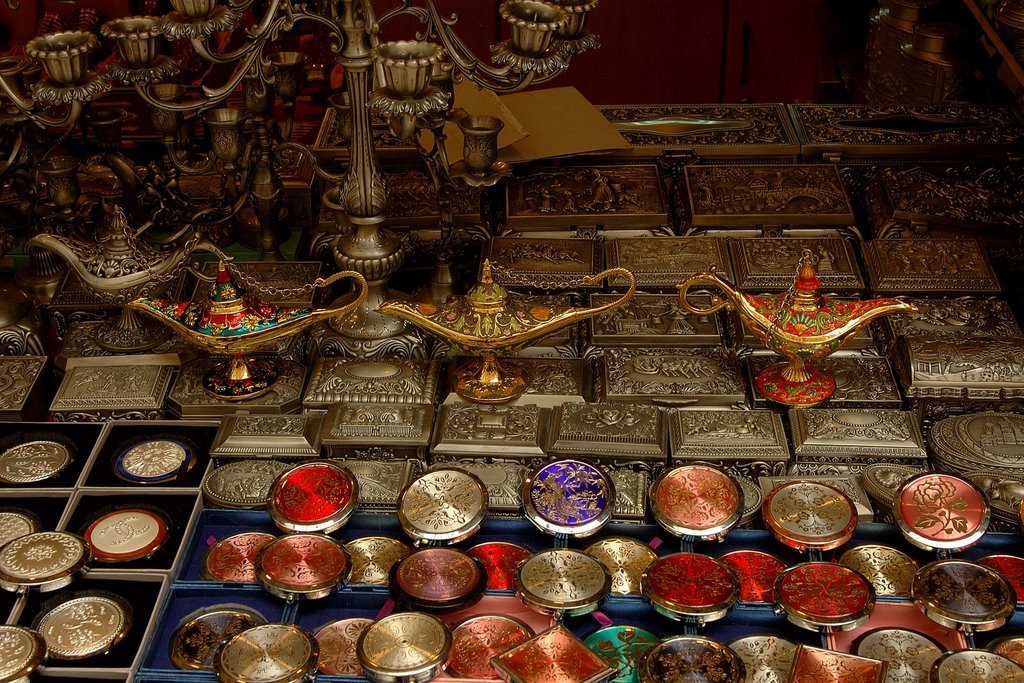
Oil lamps at Da Bazaar.
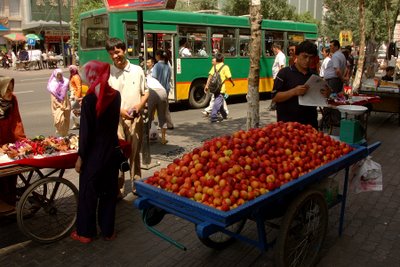

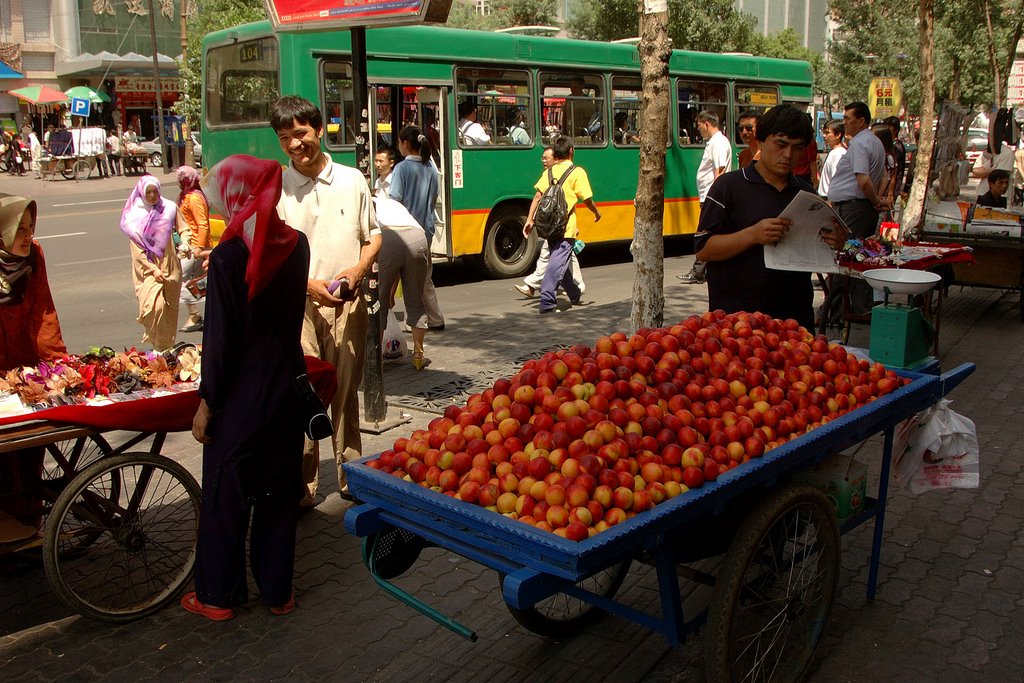
All of our students who came from Xinjiang and many others who had visited here raved about the famous fruit and everywhere we went there were melons, peaches, grapes, etc. for sale on the streets.
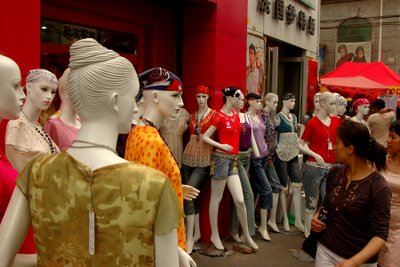

My fascination with manequins in China was piqued by this herd.


And by this counterpart to the "pycho bride" of Shanghai. Perhaps her long lost groom?
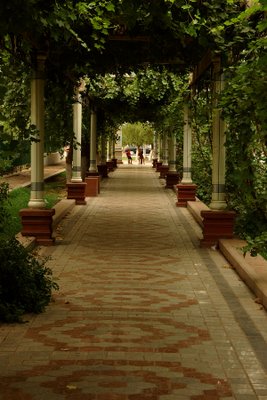

The desert oasis of Turpan (Turfan in China) is famous for grapes and raisins. We drove through a pass in the Tian Shan to get to this place which is the Chinese equivalent of death valley--below sea level nearby and extremely hot. But grape arbors provide shade and a peaceful atmosphere.
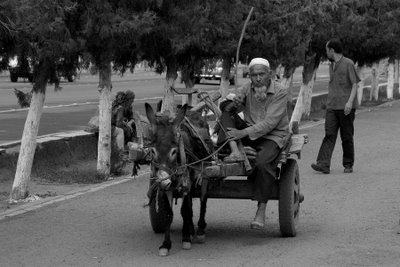

One of the common modes of transport in western China, the donkey cart.


Seman fried rice??!!
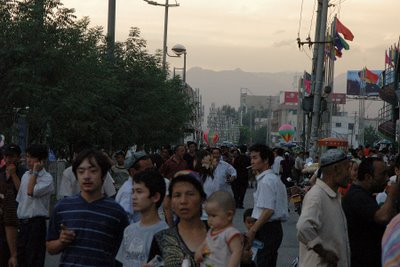

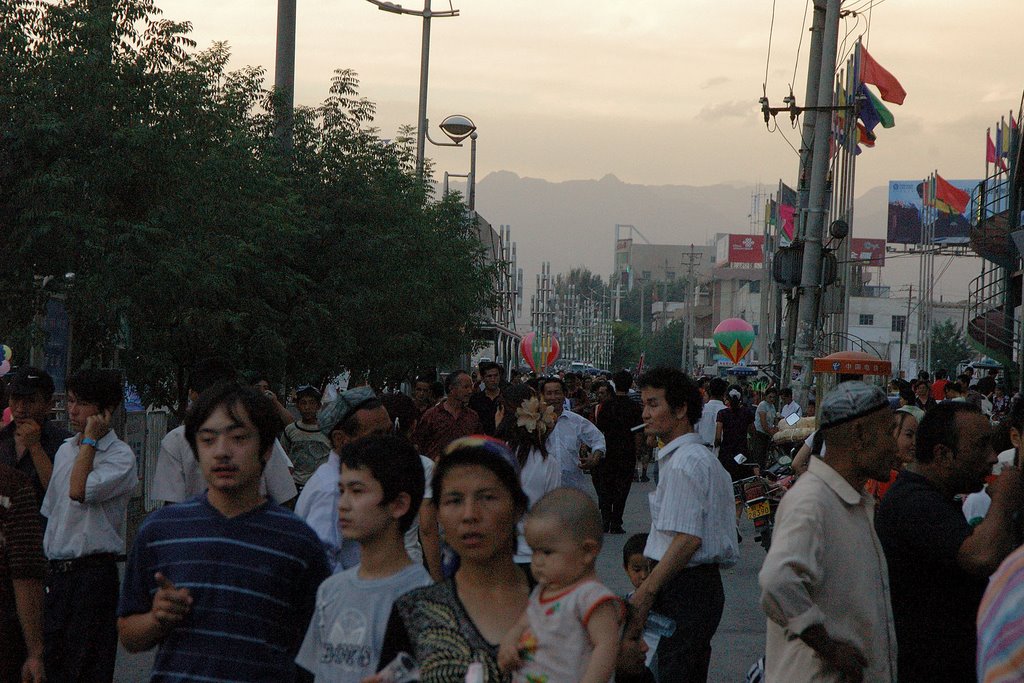
A crowd gathered in Turpan to watch a show and fireworks display.
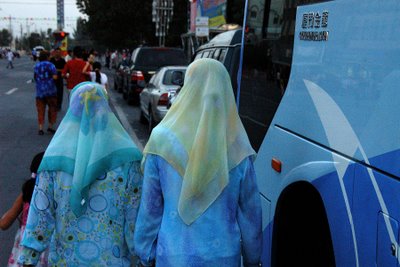

Blue.
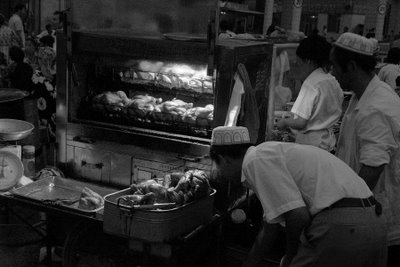

A thriving outdoor eating area in Turpan.


The desert outside of Turpan. Very dry and very hot, this desert gives rise to towns and vineyards by virtue of a huge network of wells and underground canals that have been dug and maintained for thousands of years.


The Flaming Mountains outside of Turpan.
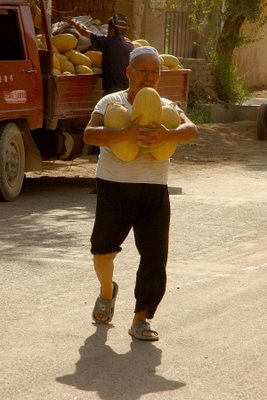

Melons are everywhere. This man was carrying a few more to a vendor outside the gate of an ancient city called Gao Cheng that we were visiting.
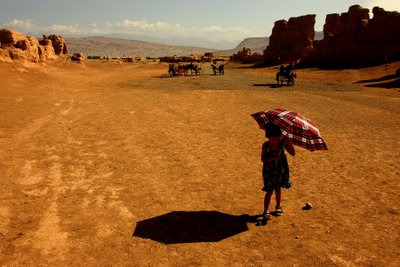


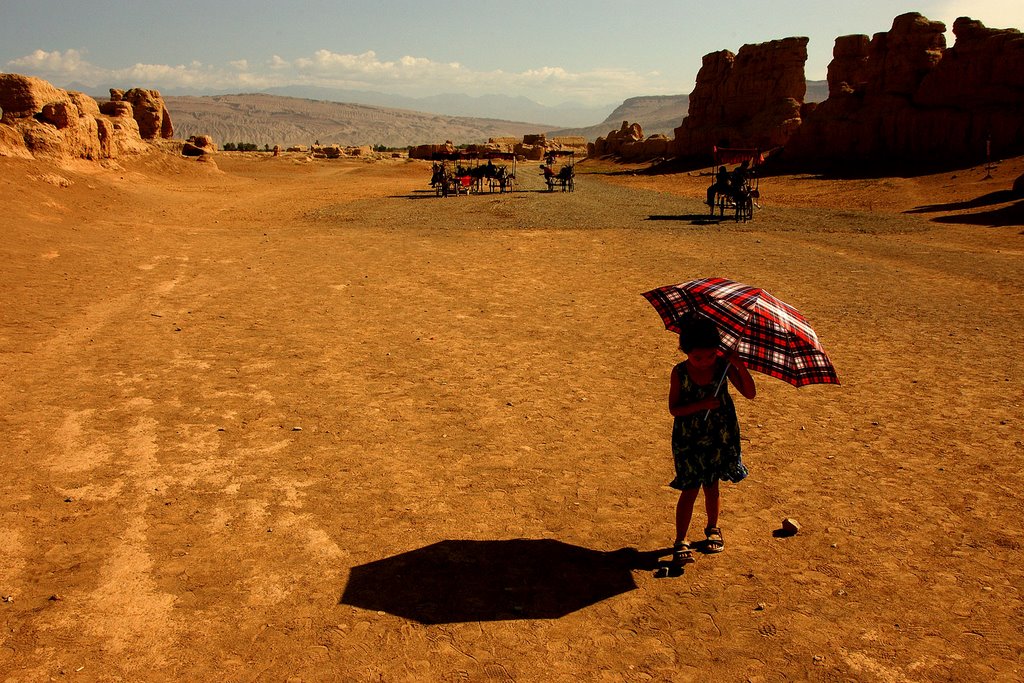
Bei protecting herself from the hot sun at the ruins of Gao Cheng.


These kids work selling tourist stuff at the entrance to Gao Cheng. As is always the case, they were very interested in Bei.


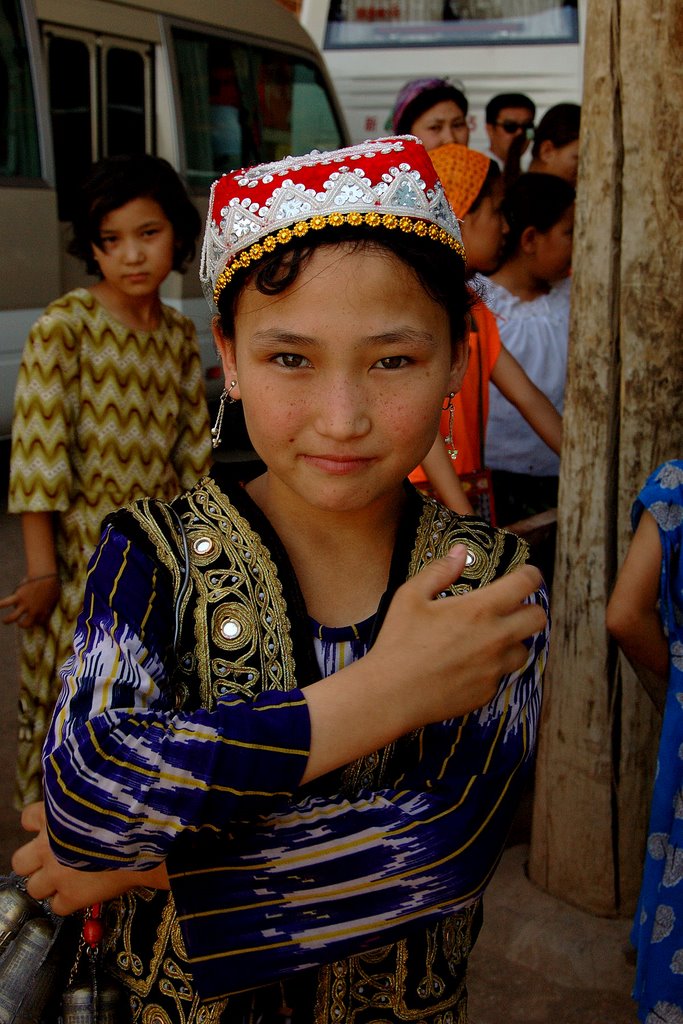
This Uighur girl posed for us and then walked back to our van so that we could take her photo with Bei.
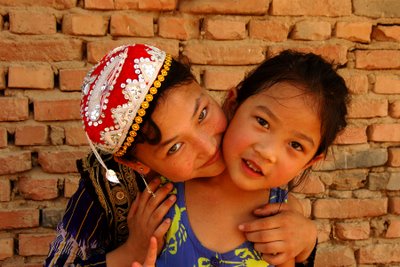

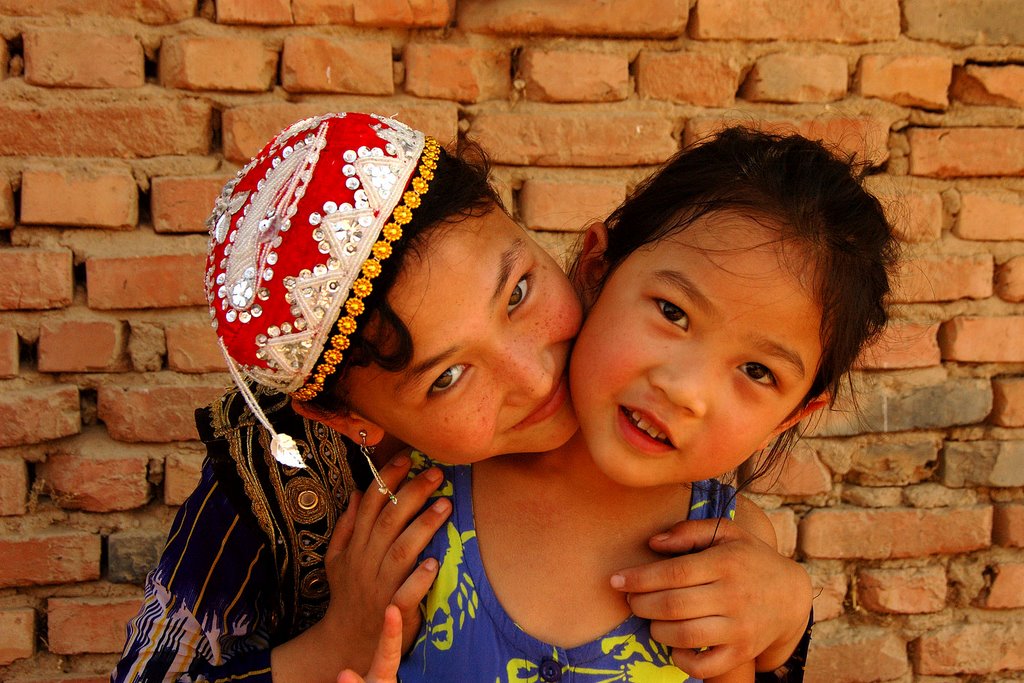
Bei with the Uighur girl from Gao Cheng.
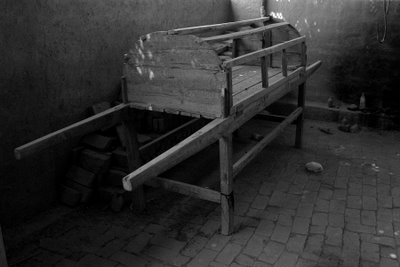

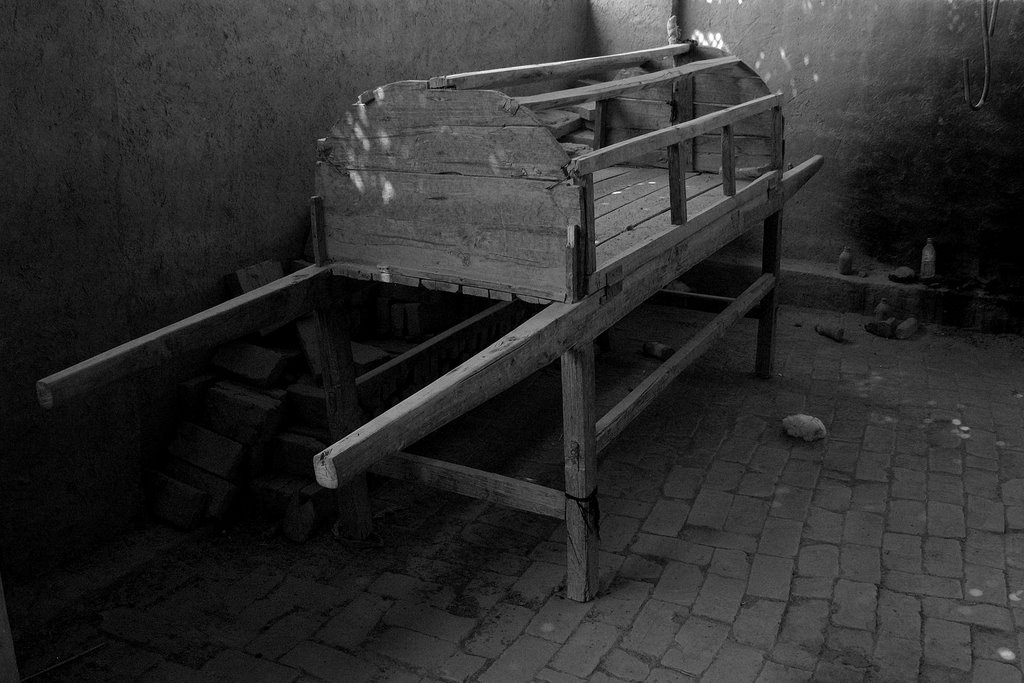
We were able to get permission to visit a Uighur cemetary outside of Gao Cheng, thanks to our driver who was Uighur. This is a body carrier.
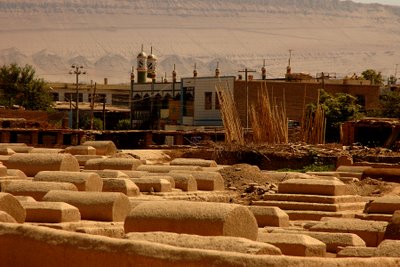

A typical Uighur (Muslim) cemetary in this area. This is the one we visited outside of Gao Cheng. The graves are expressed on the surface but often go very deep with multiple graves arranged within deep narrow pits. Wealthier families have big elaborate mausoleums, many of which were severely damaged during the Cultural Revolution. Human bones are scattered about in the dirt.

Thursday, June 15, 2006

Adoption Issues: One-child Policy, etc. (Text only)

I recently asked my writing students to produce short “memoirs” describing things in their lives that were important to them. Many of the resulting essays were overdramatic accounts of boyfriends, girlfriends or middle school teachers, but a few were considerably more substantial. I’ll share a few of them here without much interpretation since I think they speak for themselves. These essays mostly address the impact of the one-child policy in China though one (The Apple Tree) captures a sense of the loneliness of growing up away from one’s parents as many kids do in China. Out of a probably unnecessary sense of caution, I won’t provide the student’s names with these essays, since some of the opinions are critical of the one-child policy.
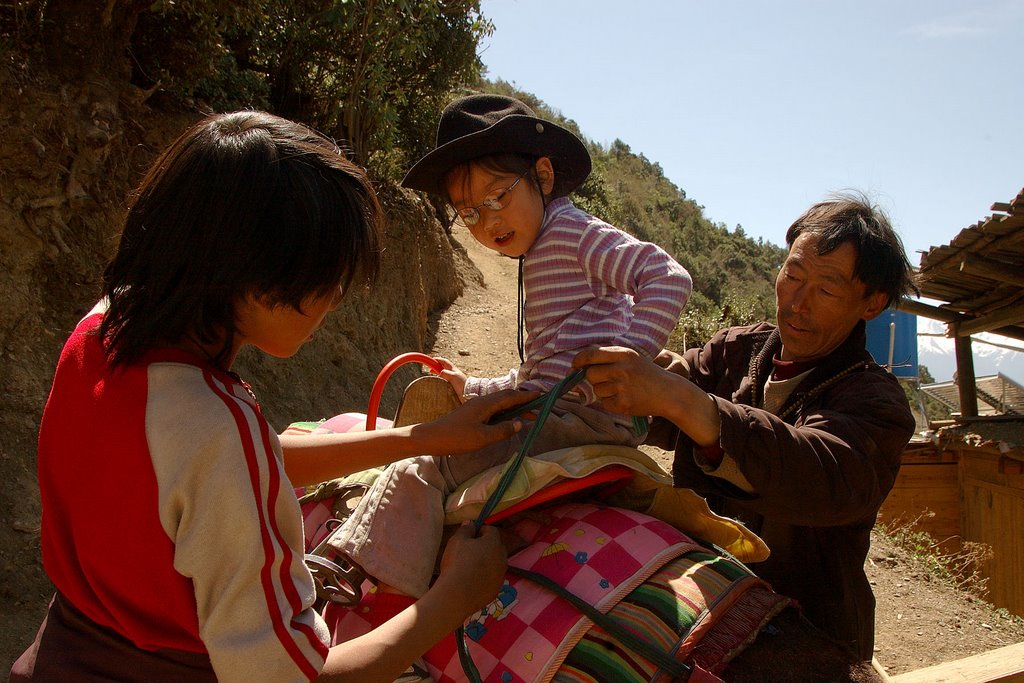
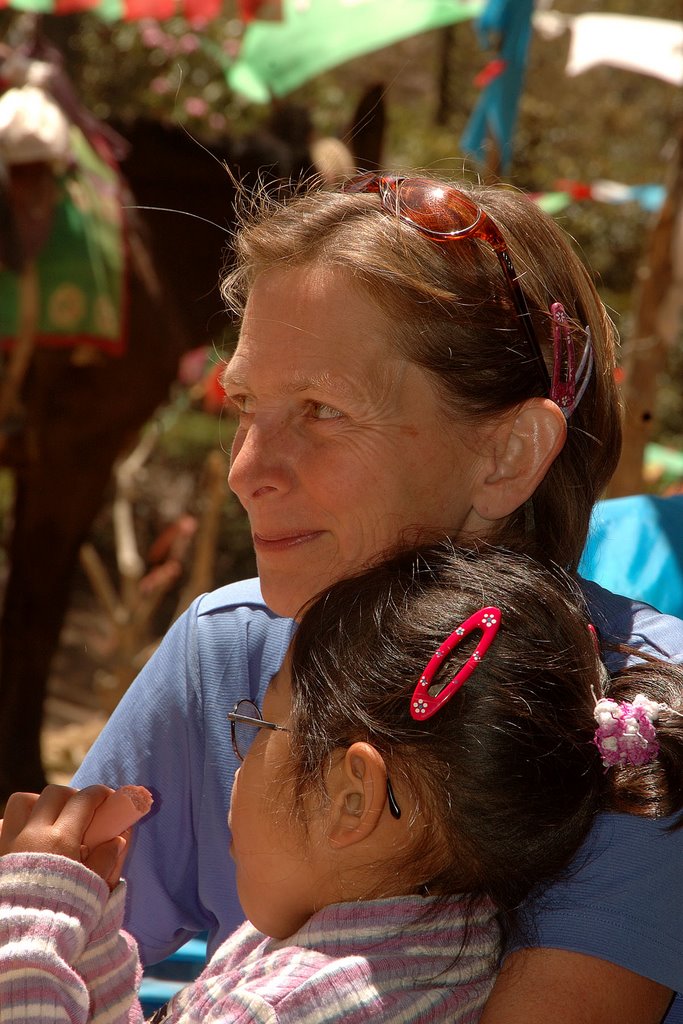

Born in 1983

If my parents didn’t tell me these things which I will never know, just like these stories I will tell you. Then you can know how hard life my parents lived through caused by me at that time.

It was 1983, a tough time in China’s history. At that time Chinese government called for One-child policy and punished the people who didn’t obey family planning. By my parents touched “the tiger’s ass.” When my elder sister was two years old, I, as the second child in my family, was born in 1983.

One month before I was born, my mother hided in home and never went out for avoiding being found by government. One month after I was born, my mother hided in a big mountain, being looked after by my aunt. The food was provided by my relatives. Being lack of sunshine and nutrition, my mother was very weak and I was valetudinarian [a person overly concerned about their health] boy when I was born.

Fire can’t be kept in paper, this is the reason why my mother hided in the mountain. At the same time, my father had been jailed in a small house. He even had been suspended on a tree for the cannot afford 700 yuan [fine]. One month later, my Grandpapa gave the money which he collected from everywhere to the government and my father was released. When my Grandpapa went to see my father in the house with a steamed bread, but he found that the house was empty – my father went to see his wife and one-month-old son immediately! 700 yuan equaled to my whole family’s one year’s income at that time!

At the same year, another child who was the second child in his family was born. His father handed out 700 yuan at once because my father was a living example. But the boy had a sonorous given name in my hometown – Seven Hundred (Qi Bai).


Birth Control

In the year I was five years old, my mother was pregnant. My Grandma told me I would have a brother or sister in the near future. On hearing that, how happy I was then. However I did not know it was against the One Child Policy. During I was looking forward to the baby’s coming, my mother was missing without letting me know why and where. I kept crying for the whole day and asked Grandma for Mum.

The next day, the local government came to my home and asked me where my Mum had gone. I was terribly afraid of them, because they all looked so fierce. In fact, they were appointed by the local government leaders as “dogs.” They shouted at my Grandma with eating the apples from the tree in our yard, and took our furniture away. I hated them, because they killed my loved dog which kept shouting towards them. Eventually, they put up a seal on our door in order to keep the family out. They fined my Dad 50,000 yuan. It was a large of money to our family then.

About one month later, my Grandma took me to the hospital to see my mother and baby brother. In the hospital, I saw two men waiting for their own baby’s coming. They were so anxious that they could not sit down but walking over and over again in the front of the delivery room. The nurse told a man of the two that he had got a baby daughter. The man was so sad and in total despair that he did not say anything but beating strongly on the wall with his fists. At this moment, the other man came to him and said, “Don’t be sad, brother, a daughter is as important as a son. Daughters are more lovely than sons.”

The nurse made a mistake, and the baby girl should be the other man’s. After he learnt the baby girl was his own, he looked as if he was crazy with the truth came like bolt out of the blue to him. “What went wrong? What did I did wrong? Why the God punishes me like this? It is my fifth daughter,” he cried. He forgot his words and did not say “a daughter is as a son” any longer.

Seeing this, I walked away with a smile.


In the adoption community we often speculate about birth mothers, but we seldom talk about birth fathers or birth siblings. The following story is an interesting one from the perspective of a sister to a boy that was given up (I’m not sure why the family gave up the elder boy and kept a younger girl).

Goodbye My Brother!

When I was in the junior school, a boy who elder than me often visited my home. At first I asked my parents who he was. My parents told me he was just our relative. But I thought our relationship were not easy day by day. Eventually, my father told me the whole story.

At a cold winter day, a beautiful boy was gives birth by my mother. When my parents saw this beautiful baby, they cried with happy tears. Then although our family were very poor at that time, they also led a happy life. But three years later, I was born. My appearance tousled my family’s peaceful life. Because of my appear, the responsibility of my family became bigger and bigger. My father told me that there was a little food to eat at that time and my older brother often didn’t eat full for me. But sometimes when my parents went out for work, my older brother took care of me carefully, although he was three years older than me. As time went by, we brought many troubles to our parents. But they did everything for us with no word.

But one day, a couple went to our family. I didn’t know who they were. I just played with my brother. But my parents were wiping tears. A moment later, that couple when out with my brother. I saw my brother and my parents were crying. I didn’t know what has happened. So I cried loudly with them.

I forgot my older brother day by day for my young. But I know my parents often sobbing at night. Until he came to my home again, my parents told me this story. I asked my parents why did thy gave my brother to other people. They said sadly: “We have no condition to bring up two children, the couple couldn’t breeding, so...We are sorry to him, but we love you!” They burst into tears. Now my brother went to abroad with his parents. I think they must having a happy life. Maybe I couldn’t see him again, but I will always remember him and love him forever.

Goodbye, my brother!


An Apple Tree

When I was five years old, I lived together with my grandmother in the countryside because my parents’ work were very busy and they had no time to take care of me. I could remember that there was a big apple tree in her garden. I had a good time on this tree. So, this tree became my friend when I was a child.

The trees leaves was so much that they could help me to cover sunshine. When spring coming the bird song on the branch. In those days, I always wanted to catch a bird. I couldn’t catch them because when they saw me toward to them, they flied away quickly. The branch was so big that I could sleep on its. When I felt tired, I slept on this tree as my bed. I often saw some butterflies surrounding me. In my dream, I always became a beautiful butterfly to fly into the blue sky.

My Grandmother loved me very much. I took my whole days in this tree, and she also did her housework under this tree. She didn’t know why this tree attracted me so deeply and what did I do in this tree? She often asked me: “Do you eat in there?”

“Yes,” I answered.

Then, she got into home and gave food to me. So, I sat the branch to eat my lunch. I thought this tree maybe was my heaven...

Now, I was far from this tree and my Grandmother to enter University. Many times I dreamed I was on an apple tree and my Grandmother did her housework under the tree.

Thursday, June 08, 2006

Yubeng 2 -- The Tourism Dilemma

First, let me say that things are getting a little busy around here with our impending departure. We finish teaching on June 23 and then will travel until the 19th of July when we fly to the U.S. We’re in the midst of finishing a semester, packing the formidable pile of stuff that we’ve accumulated, shipping things back to ourselves, trying to plan a lot of in and out of China travel and saying goodbyes to friends and students. All to say that blog entries are going to be sparse for a while. I’ll continue blogging here in China and after we return to the U.S. until I have worked through a long list of topics that I’d like to discuss (not the least of which is our planned orphanage visits). But it may take a while. For now, I’ll relate a trip back north to the Meili Snow Mountains and Yubeng that we did over the May holiday (WuYi).


Visiting a tiny, traditional Tibetan village huddled at the base of enormous glaciated peaks on the Yunnan frontier is a once in a lifetime experience worth repeating. And since Bei and Ellen hadn’t had the chance, we returned to Yubeng over the May 1 (WuYi) holiday, along with hordes of Chinese tourists, also eager to experience “nature” and “Tibet.”


Yubeng is beautiful and increased tourism is inevitable.


Tourists get their first glimpse of the Yubeng valley from this pass, where they can also buy bottled drinks and other trash-producing snacks.

Traditional villages anywhere in the world offer tourists the ever more unusual opportunity to glimpse ways of life quickly being consumed by roads, cell phones and the relentless onslaught of the growing global economy. We Westerners are especially drawn to places that are “untouched.” But the very act of observing changes the thing being observed in profound ways (just ask Heisenberg. Our return to Yubeng was a great chance to see a still-beautiful and largely traditional Tibetan-style village, but it was also tainted by the realization that the huge mobs of tourists (that we were a part of) who descend on this tiny place are rapidly changing the very thing they come so far to see.


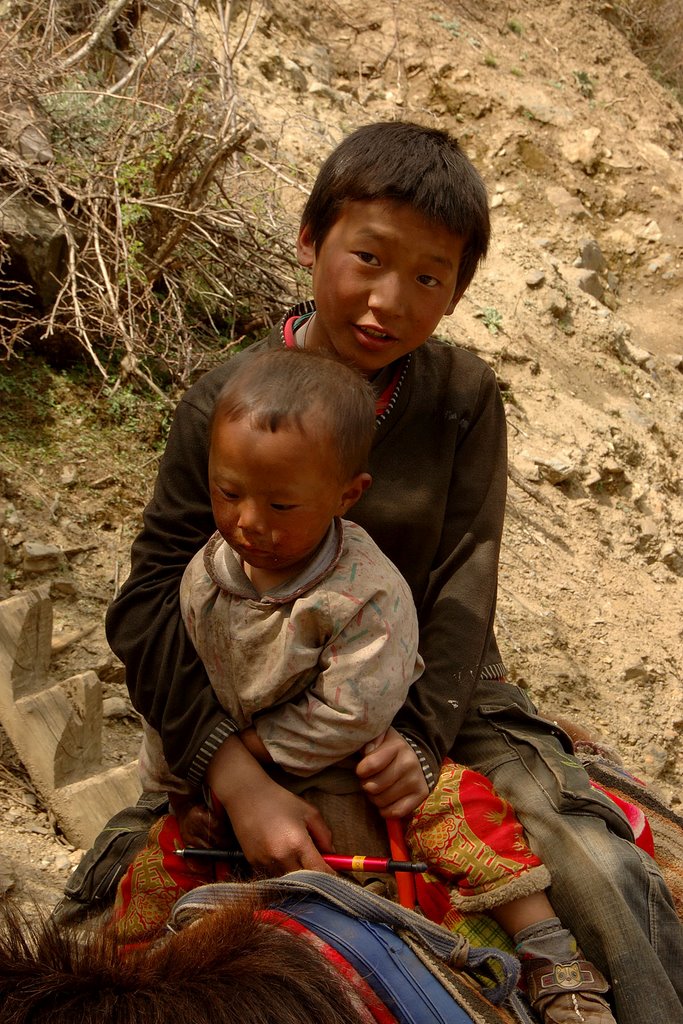
Young boys ride a horse through Yubeng. What will life be like for them 10 years from now? And what will their children's lives be like?


Tourists crossing the pass into Yubeng.

An editorial published on May 12 in The New York Times described a tribe (the Nukak) from the jungles of Colombia that recently renounced their traditional ways to move from ancestral lands into a more modern village. The Times commented:

“We have no clearer idea what it would mean to live a subsistence life in the Colombian jungle than the Nukak have of living even on the fringes of the modern world. In one sense, there has never been a better time for a people like the Nukak to leave the wild. They'll find medical care, sustenance and a genuine attempt at cultural respect that would have been impossible years ago. Yet the fact that they're leaving suggests how much their world — and ours — has been impaired.

The Nukak have every right to make this decision for themselves. But it's hard to escape the feeling that their self-sustaining existence — which went almost entirely unnoticed by the rest of the world — was holding something open for us, something that has now been lost.”


Yubeng, of course, is not a tribal village in the Colombian jungle, but some of the issues are analogous. The village is small – it had 133 residents in 2001 and I doubt that the population has changed substantially in 5 years. Yubeng is isolated—there is no road access and the foot-trail to the village climbs steeply over a mountain pass that can be blocked by snow in the winter. The people of Yubeng, though not isolated from the outside world, still live a simple life—cutting timber, raising yaks and other animals and farming on the small areas flat enough to be plowed. And life has been hard here. Health care is difficult to access and other services are nonexistent. In a 2001 New York Times piece by Erik Eckholm, the author says:

"But if this is almost paradise, that "almost" contains a world of sorrows the people of Yubeng could do without.

Mr. Aqianbu [a Yubeng resident and guest house owner] matter-of-factly gave an example. He, his younger brother and the wife they share, in the polyandrous triangle common to the region, have watched three of their four babies die -- a result of the near-total lack of modern medicine, the poor sanitation and nutrition and, ultimately, the poverty and isolation of a village that is an arduous six-hour hike from the nearest dirt road.

They are proud of their surviving daughter, but they are not happy that to attend school beyond the third grade she must make that same hike over a high mountain pass, then stay at school for two weeks at a time, paying dormitory fees that are a terrible strain."


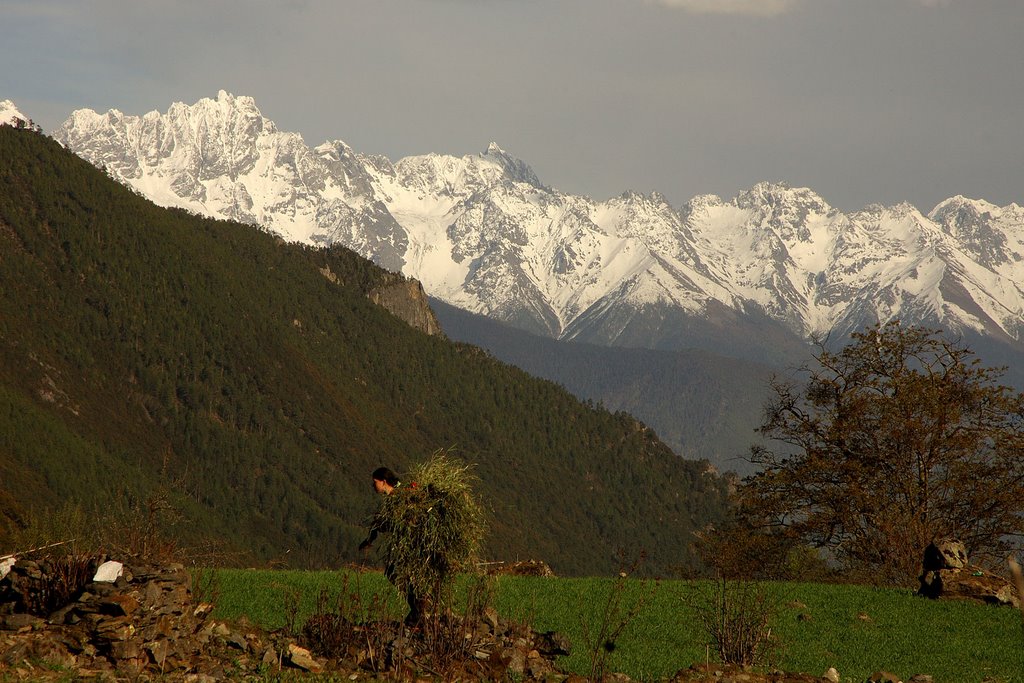
A woman carries a load from the Yubeng fields back to her house. Farming is hard work and the lure of a tourist economy is strong.

Our friends Scott Lehman and Bay Roberts visited Yubeng several years ago before it became so visible on the tourism circuit and Scott constructed the first outhouse (suitable for “western wide rides” according to Scott) in the village. Outhouses, along with visitors, now abound though they are often poorly constructed, thoughtlessly located, and overused so that raw sewage finds its way into the streams that run through the valley on their way to the Mekong several miles downstream.


Our guesthouse in Yubeng. One of many that are being built to accomodate increased numbers of tourists.

When I visited Yubeng alone in February, there were a few Chinese tourists in town and guesthouses were quiet. One could imagine the village as it has been for hundreds of years and could, with little effort, explore the area with only yaks and pigs for company.

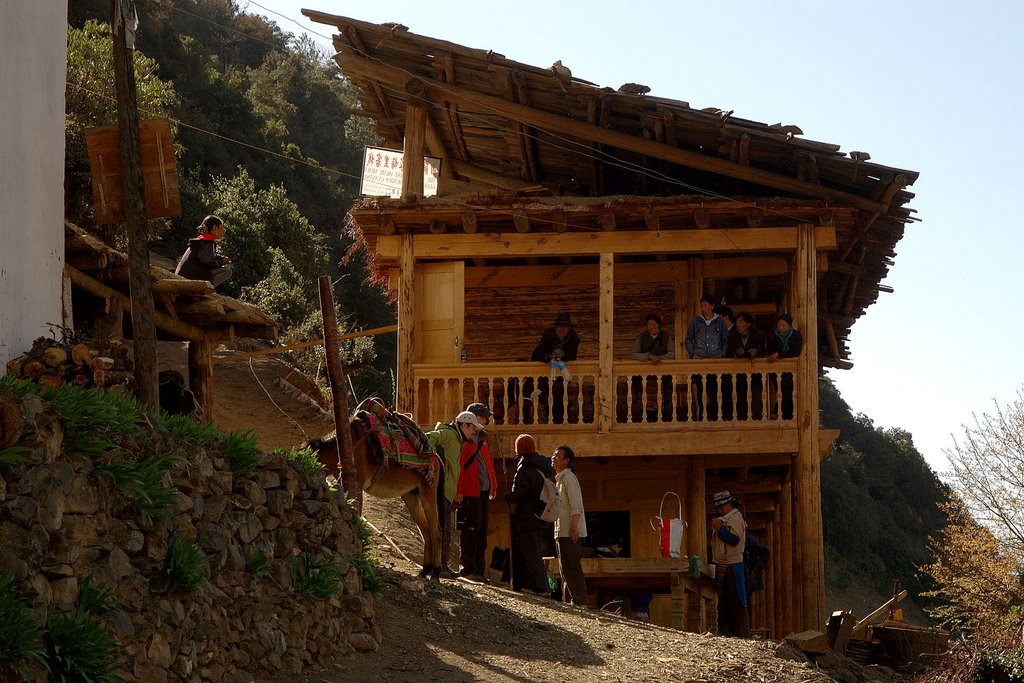
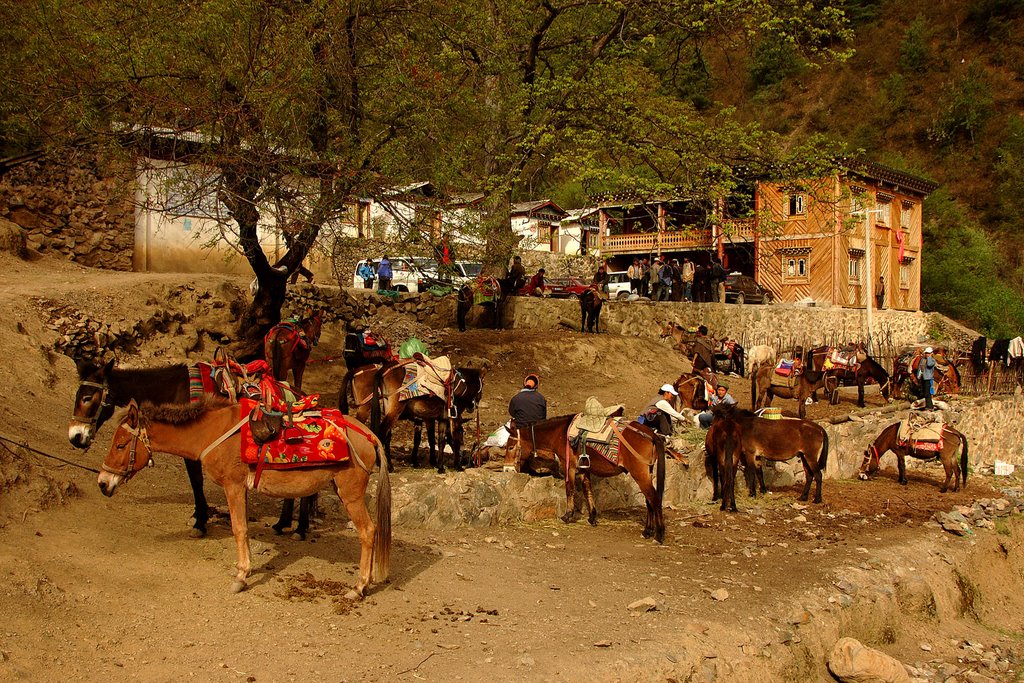
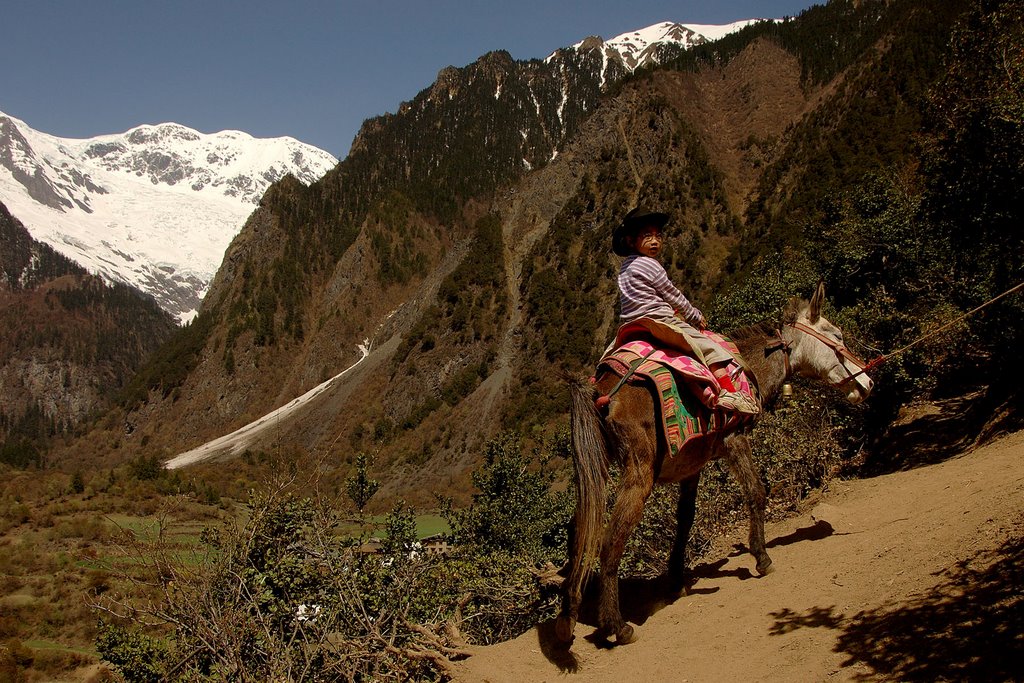
But the May 1 holiday in China is like Spring Break for the entire country, and the scene at Yubeng had utterly changed. We hiked from the trailhead accompanied by an almost continuous stream of Chinese tourists (over 200 per day over the holidays, we were told), most on horses led by hard-working locals who sometimes make two trips a day over the pass to maximize their salaries (horse + horse packer costs 160 yuan per trip, which is about $20, a sizeable sum in rural China). Not only do the horsepackers rush up and down the mountain pulling often reluctant horses and mules, but they often do so while carrying the substantial backpacks of their clients. They are so fit that it is an endurance workout to try to keep up with them (Bei rode a horse, so we ran along behind).


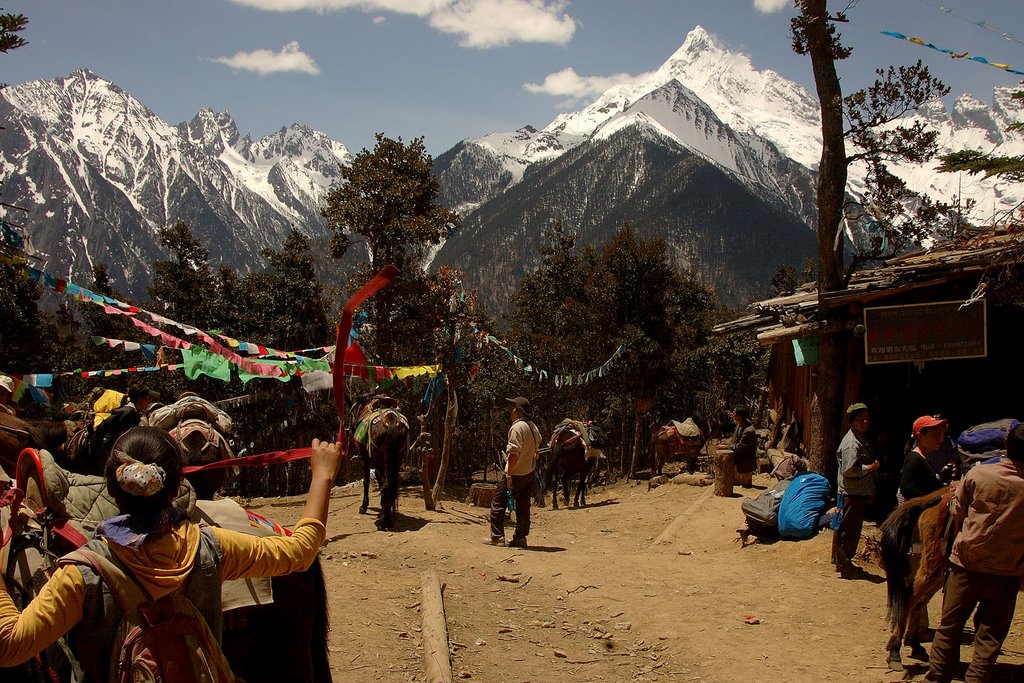
The trailhead for the trip to Yubeng. The once sleepy place is a mob of tourists and horses, waiting to join forces for the trip over the pass.

For many Chinese, outdoor recreation is a new pastime—the emerging middle class I suppose – and they struggle with great determination to reach places like Yubeng. Those on horses often seem to be doing all in their power to insulate themselves from the “nature” that they came to see. Riding in the hot sun, they dress in full gortex suits, boots, gators and substantial sun hats. We passed one group of older tourists who added to this outfit a complete facial wrap of thin gauzy material and large sunglasses to prevent sun from touching any skin, so that they resembled Saharan Touregs riding camels across blistering dunes.

The disconnect between man and the environment among many Chinese manifests itself in an oblivious disregard for the effects of so many people. Trash is a big problem and the area along the trail, which climbs through fir forest and blossoming rhododendron stands, was littered with plastic bottles, food wrappers, toilet paper and other refuse. Above snowline while on a dayhike, I saw tree-wells where trash accumulated on melting snow. In the village itself, workers cleaning rooms tossed refuse off of balconies onto steep hillsides to contribute to terracing efforts in front of the buildings (making ever larger viewing platforms for tourists atop the trash). A picturesque stupa in the upper village sits beside a plastic bottle dump, where thousands of drinking water containers are sequestered in a small fenced area to slowly decompose in the sun.


This area near a stupa, though beautiful, is also right beside a large dump where plastic bottles and other refuse are tossed into a small, fenced area.

And the flow of people like ourselves also brings change by virtue of the money we pour into the local economy. If you were a villager, would you preserve subsistence farming and a “quaint” lifestyle or would you engage with the lucrative tourist trade?

There is much construction in Yubeng these days and many families have upgraded their traditional Tibetan courtyard homes into tourist guest houses (still rustic). And who can blame them? In 2001 Eckholm wrote that:

"Now the people of the region, especially in more pristine places like Yubeng, are facing a challenge that many other parts of China have already failed: finding a way to prosper, while preserving their unique environment.

To solve this problem, the people of Yubeng are engaged in an unusual dialogue about their future -- part of a collaboration between the Yunnan government and the United States-based Nature Conservancy, one of the largest private international conservation groups.

"The goal of the Nature Conservancy is to protect biodiversity," said Rose Niu, a 39-year-old member of Yunnan's Naxi minority group who has a master's degree in resource management and directs the conservancy's China project.

"But here, it's very clear that you can't protect nature unless you work together with local communities and preserve the culture too," she said. "We especially need to promote the traditions calling for harmony with nature.""


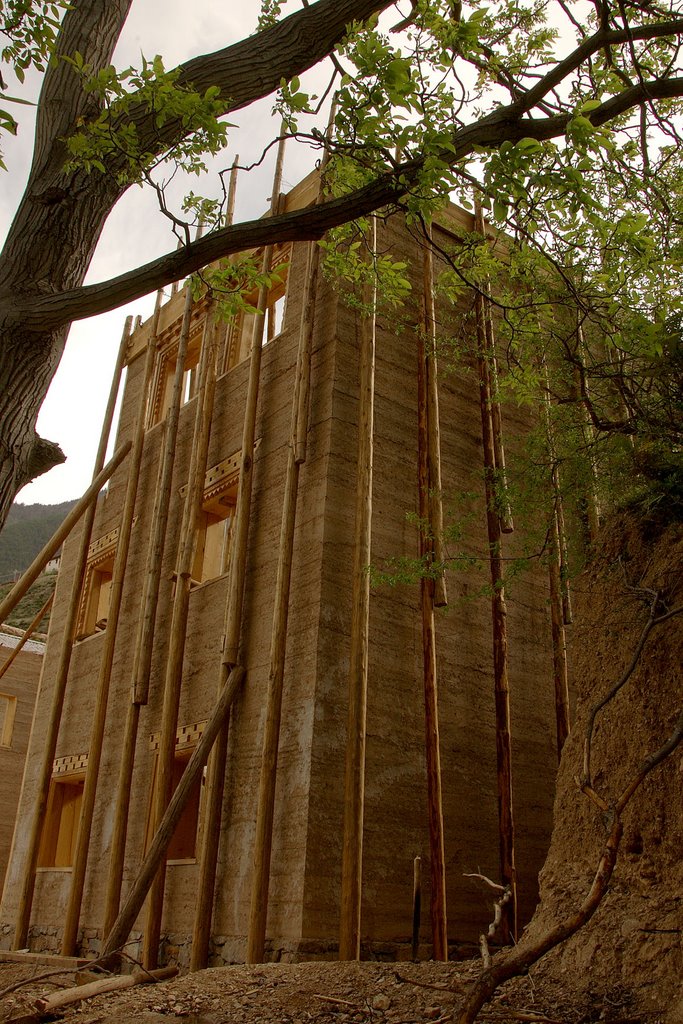
Houses in this area are built of rammed earth and huge timbers culled from rare mature forest. Though logging was outlawed in 1998, villages still have rights to use forest resources.


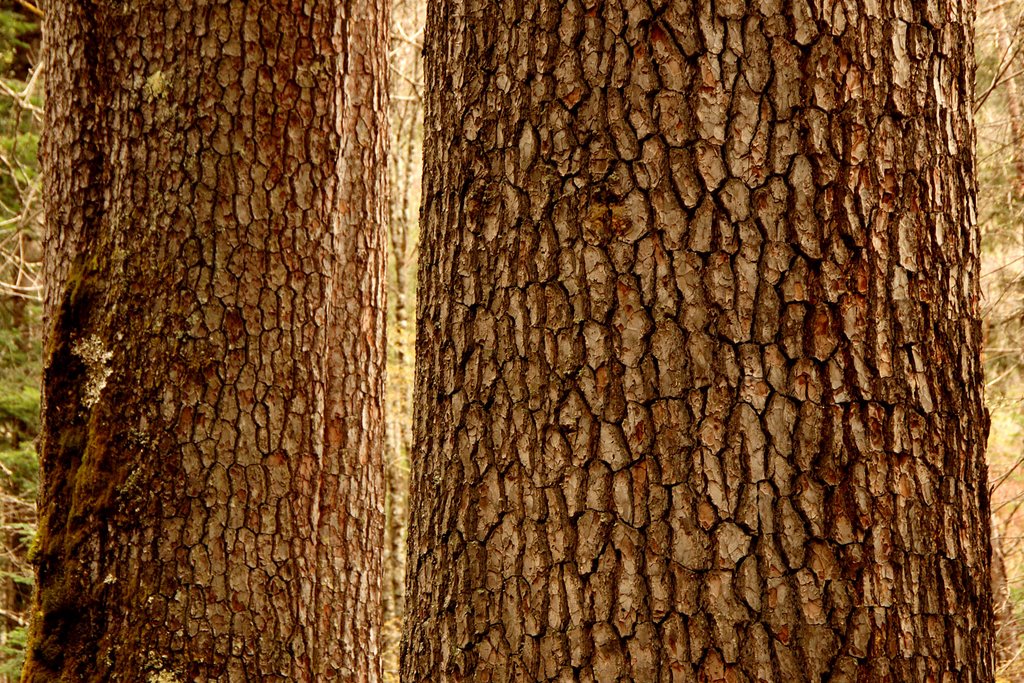
There are big trees around Yubeng--a rarity in our experience in Yunnan. But many of these trees are used for the enormous posts that are part of traditional architecture in this area.


A water powered sawmill for cutting logs into boards. This mill near Yubeng appeared to be abandoned.


Boards stacked to dry near Yubeng. I believe that these are milled using chainsaws or other gas powered tools, though I'm not certain.

After our trip to Yubeng in May, I’d have to conclude that at least in some important ways, the challenges expressed so hopefully by Ms. Niu are not being met. What Yubeng needs is a sustainable way to support the inevitable increase in tourism that has already been unleashed on an area too beautiful to remain secret, while giving the people there a chance to prosper without destroying the very thing tourists come to see.

At the end of his article, Eckholm quoted a man named Amu, one of two village chiefs when the article was written in 2001:

“Of course, all of us are looking forward to a better life," he [Amu] said. "We need a road most of all, and we need a bigger hydropower station to give us steady electricity for cooking."

“We see tourism as our best hope," Mr. Amu said. "We welcome more tourists here, but those that bring destruction will not be allowed.”


And although if I lived in a village where my daughter’s life was in danger because of the lack of accessible medical care, I too would wish for a road, I also have to hope for and wonder if there are other solutions – regular visits to the village by doctors, establishment of a clinic supported by tourism and conservation dollars or other creative programs. For is not just tourists who “bring destruction” to pristine places in China.

The Nature Conservancy (TNC) is one organization that recognizes the huge opportunities that we have in China to preserve both culture and an unequaled environmental resource. I have to hope that groups like this have the capability of making a big difference. TNC states on one of their web pages that:

"To meet the conservation needs of this area and its people, the Conservancy has completed a draft resource management plan for Meili Snow Mountain that places special emphasis on reducing the threats of future mass tourism projects. Moreover, the Conservancy will continue to work closely with Tibetan communities, government officials, and technical experts to implement the plan."

To be successful in places like Yubeng, these plans require an influx of money from outside (and inside) China and letters expressing the hope that solutions can be found that address the very real problems faced by local people while at the same time preserving what is left of this place and culture.

If any of you are interested, TNC has an excellent web site for their China program:

The Nature Conservancy China Program

And it is not too late. The Meili Mountains are still beautiful, the Yubeng valley is still spectacular and the people who live there still lead a simple life tied largely to the land. On our last day in Yubeng before joining the hordes for the hike out to “civilization” Ellen and I took turns walking through the upper village to a stream where the rhododendrons were particularly spectacular. On her way back through the village, Ellen was startled by villagers announcing excitedly to one another: “Feiji! Feiji!”

As one they turned their heads upwards to watch a single passenger jet pierce the Tibetan sky.


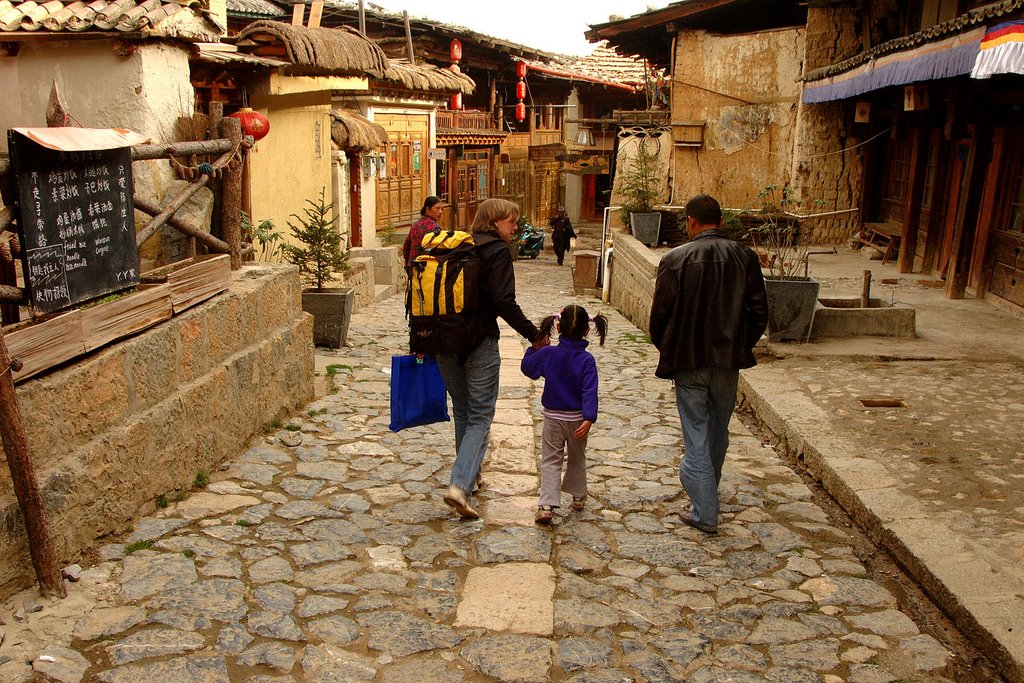
Ellen and Bei on their way to our ride to Deqin walk through "Old Town" Zhongdian. Much of old town has been constructed recently for tourists and much is still under construction.


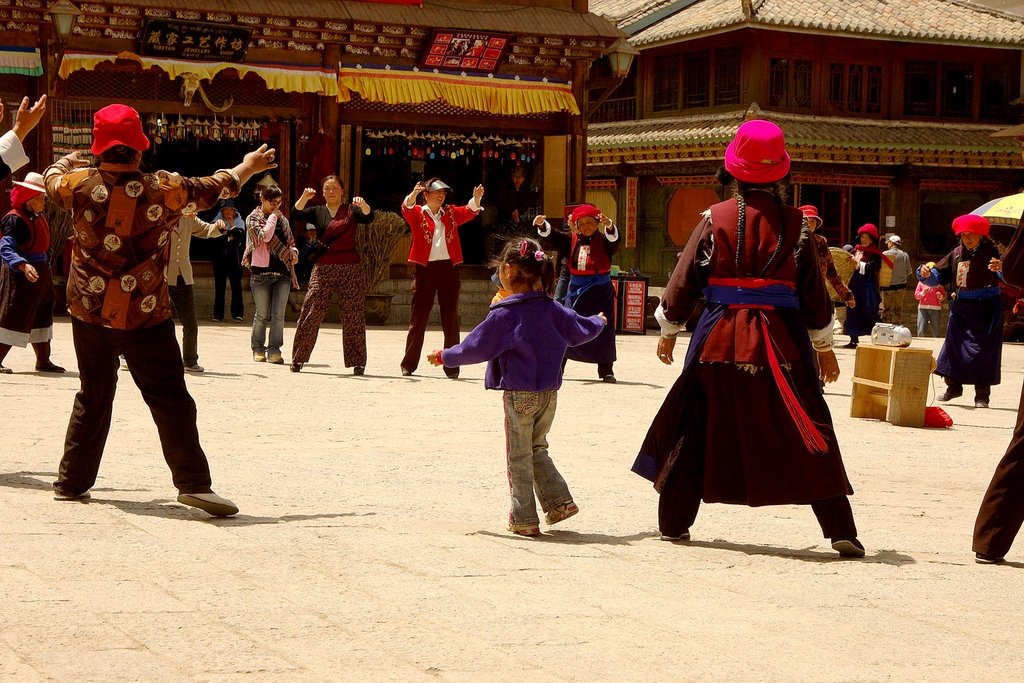
Bei dances with the locals in Zhongdian. We were told that the dancing was original forced by the government to promote tourism but has since taken on a life of its own among both tourists and locals.


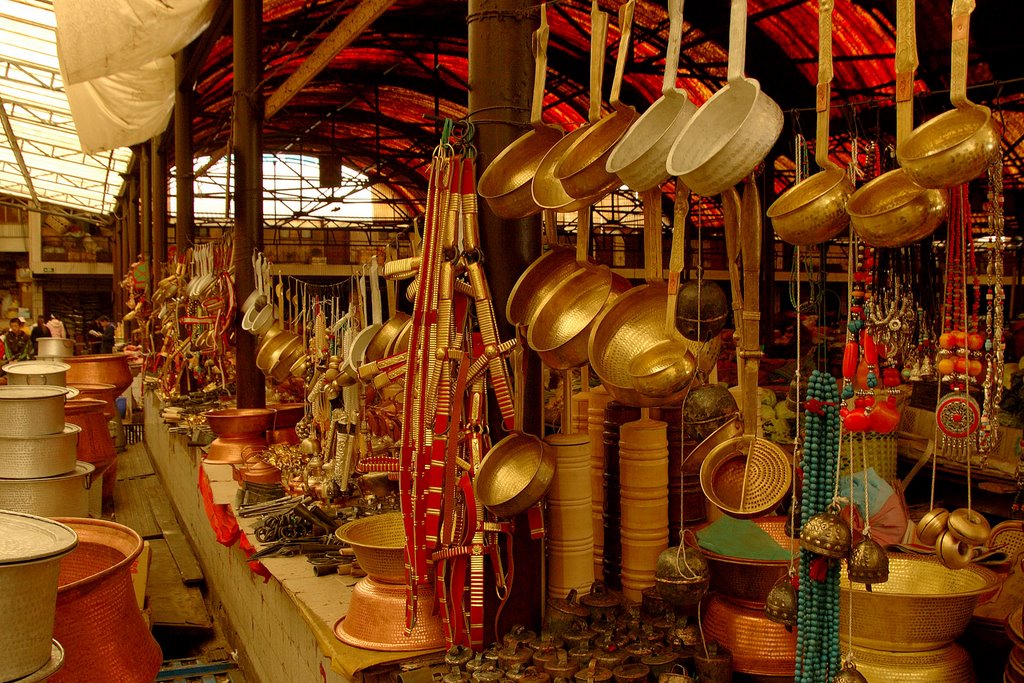
Things for sale in a Zhongdian market frequented by locals and tourists.


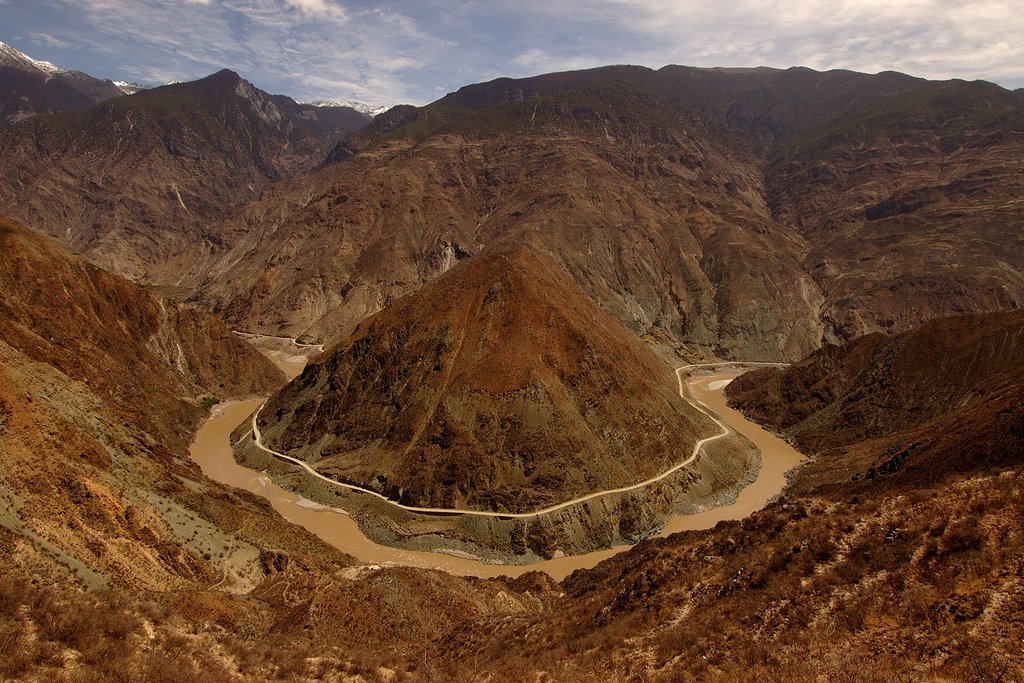
One of several "first bends" of the Yangze River. This is a standard stop for tourists on their way north from Zhongdian.


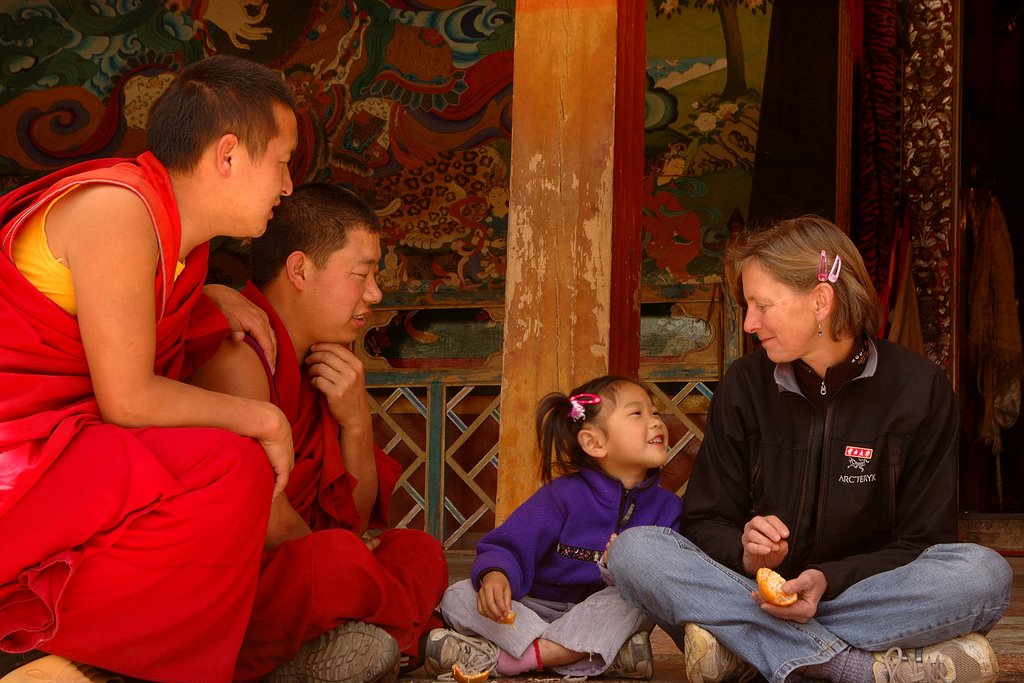
Bei and Ellen visiting with monks at a monastery near the town of Benzilan north of Zhongdian. Bei and the monks were mutually fascinated.


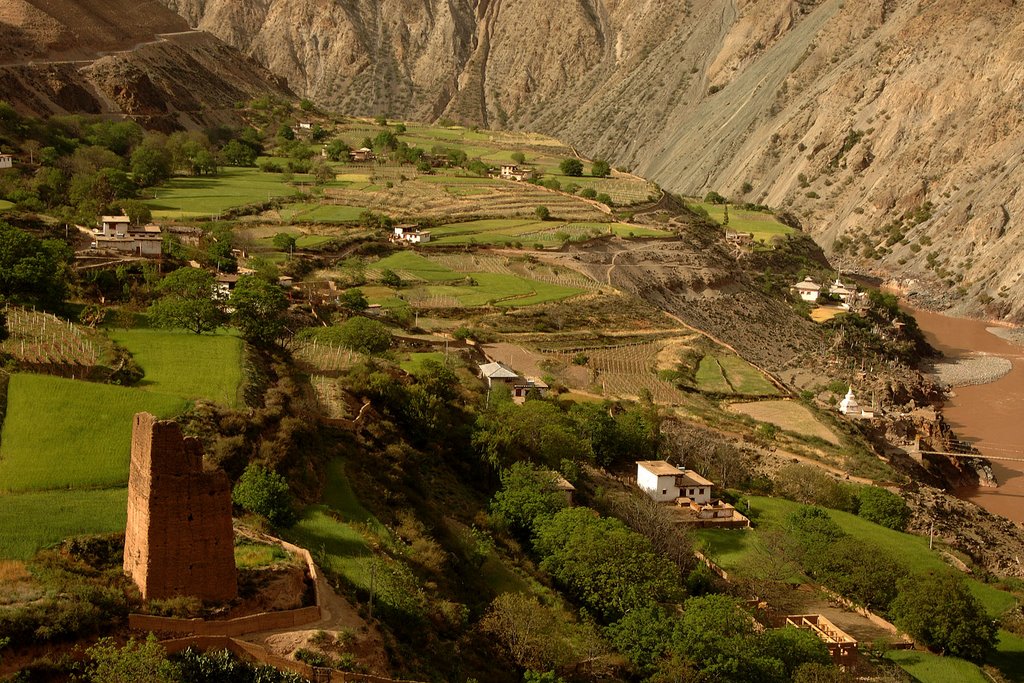
Bei and I in Xidang above the Mekong River.


A detail from a stupa in Xidang near the Yubeng trailhead.


Crumbling tower in Xidang.


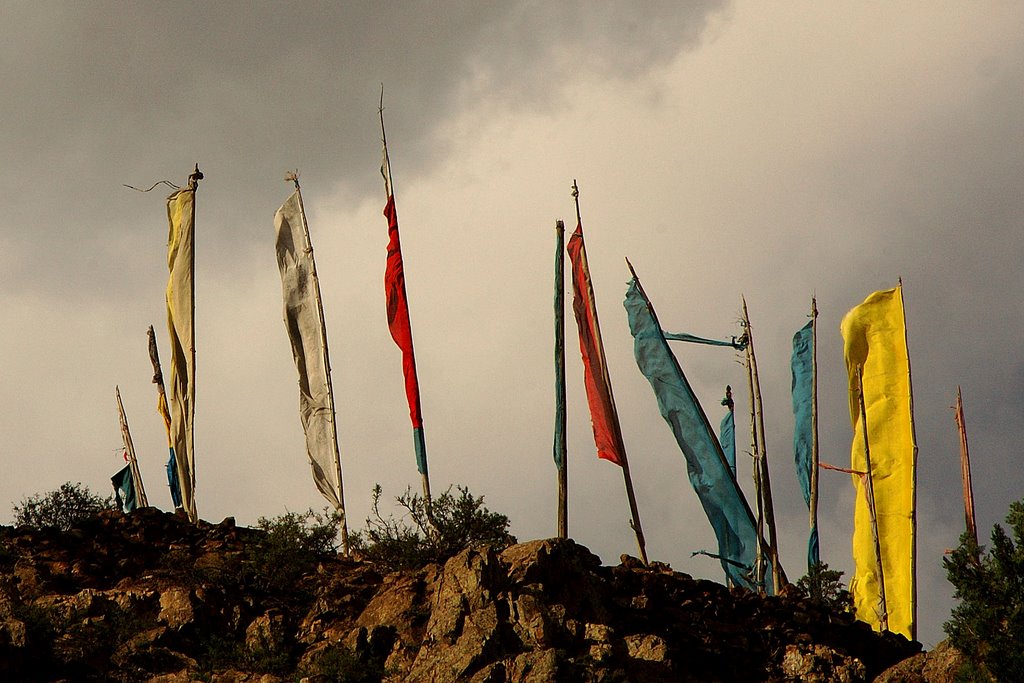
Prayer flags on a ridge above Xidang.


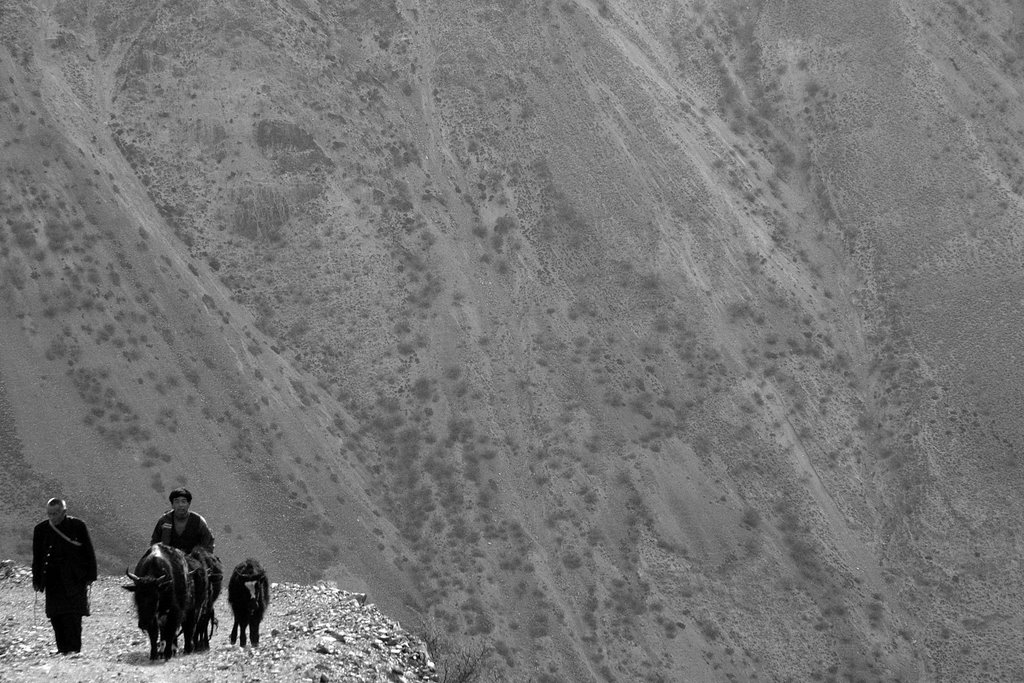
Herders move along a dirt road above Xidang. The steep terrain in the background is typical of the country along the Mekong and access to the area is difficult as a result.


Bei leaving Yubeng.


A string of horses and mules carrying tourists and gear into Yubeng for the holiday.


The Meili Snow Mountains. Not only is the village itself beautiful, but it rests just below peaks like this. How can tourists not come here?


Rhododendrons in bloom near Yubeng.


The afternoon view across the fields and forests near upper Yubeng.


A bench near the upper village of Yubeng. Afternoon light highlights the trees that were flush with new leaves when we were there in early May.


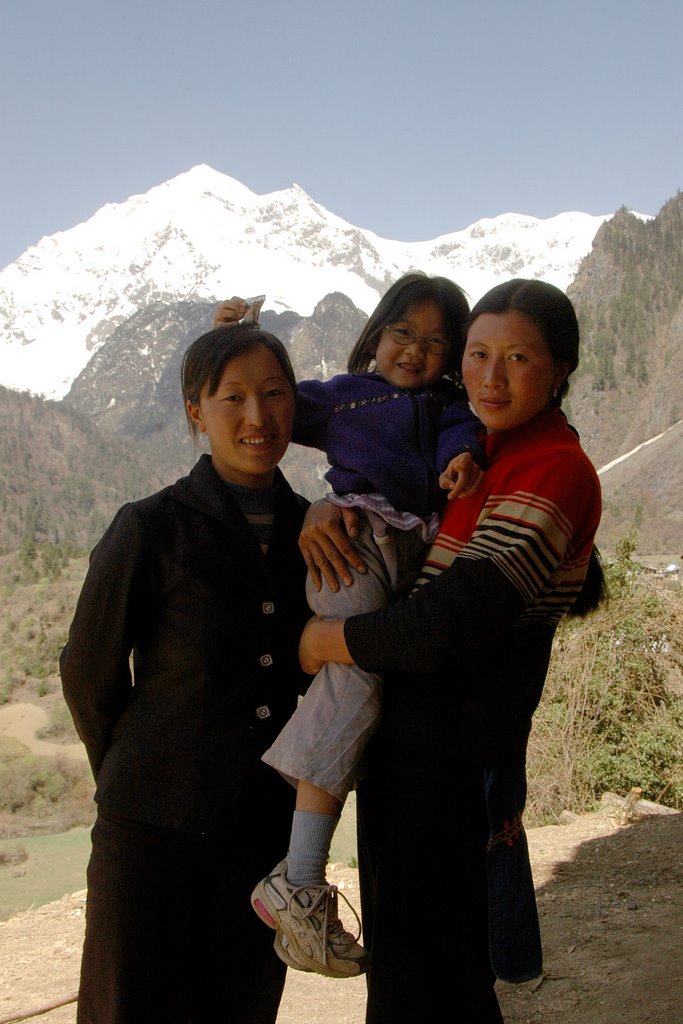
Bei with a couple of the women that are part of the family that owns the guesthouse where we stayed.


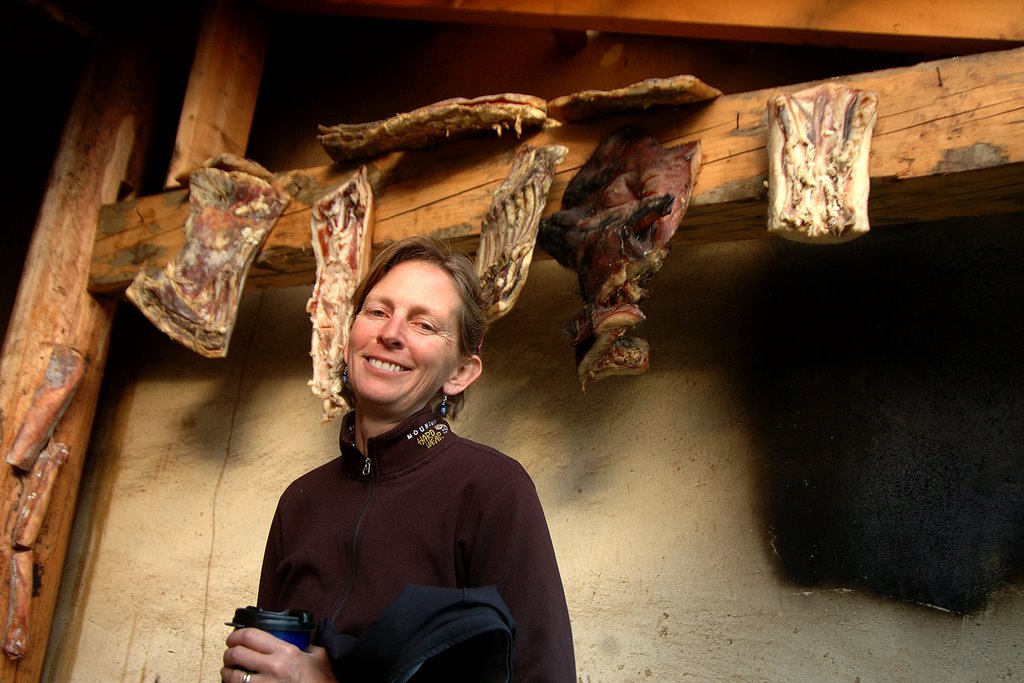
Ellen in the dining room at the Yubeng guesthouse where we stayed. When I took this photo she was unaware of the backdrop lurking behind her.


Tourists and their baggage catch a ride through upper Yubeng in the back of a tractor.


Rhododendrons near Yubeng. Yunnan is famous for them and they bloom all summer long.


A view from the fields near the upper village of Yubeng.


Locals watching the steady stream of tourists pouring into the village below.


Bei preparing to leave Yubeng on her trusty steed.


Bei and Ellen on the pass above Yubeng on our way out.

Monday, May 22, 2006

Commuting

Ellen doesn’t love my favorite 30-minute bicycle commute from Gu Cheng(Old Town) to the da xue (college). It has to do with her aversion to dust—dust that settles into your hair and sticks to your teeth as you bounce along through road construction behind a wheezing dump truck. But for me, the alternative route up the well-maintained but less direct Shangrila Lu adds minutes to my trip which I usually don’t have to spare, and offers less interesting, though by no means boring, sights. So several times a week, I eat dust and Ellen pedals on the pavement.


Ellen's preferred route follows Shangrila Street from town out to the school. The views are not too bad and the road is not devoid of cultural interest either.


"Stick" tree plantings along the Shangrila route to school. Ellen is flabbergasted that these miserable sticks, stuffed into the ground and given minimal water, eventually thrive and become trees. But it's true.


Our commute doesn't leave us looking quite a clean and perky as this shampoo model on a billboard in Lijiang.

To put this into perspective I should say that we’re already beginning to grieve (not too strong a word) our late July departure from this extraordinary place. It isn’t just the trips we’ve taken that we’ll miss. It’s also daily life; the glimpses of things simultaneously insignificant and remarkable. These glimpses will be remembered as fondly as sunrises on big mountains or shadows settling along the Yangze. The 30-minute bicycle commute each day is part of our mental landscape and on almost every ride, I see something that I want to remember.


Images like this are part of every day and every trip out of the house.

A typical teaching day for us begins at about 6:00 a.m. when we open our eyes and, from under the heavy comforter on our cobbled-together but comfortable bed (foam mattresses atop roughcut boards resting precariously on stacks of bricks constrained within a dilapidated frame), have a look through open louver doors into the courtyard, still in shadow, and to the sky, just growing light. If we sleep a little late the sun wakes us up, reflecting off the chrome tank that feeds the solar hot water heater which on a sunny day will produce plenty of water for dribbling gravity-fed showers. But we don’t worry as much about hygiene here as we do in the States, and showers can usually wait for hot afternoons, when the breeze that filters through the mostly open cinder-block bathroom doesn’t seem so daunting.


The courtyard of our house in Old Town. The pebble surface makes for wobbly trips to the bathroom in the middle of the night but it is a nice place to wake up in the morning.


Our solar hot water heater. "China's best brand" according to the decal.

Living in a courtyard house is a little like camping out. There is no heat unless you huddle around an electric space heater, light a charcoal fire in a brazier or leave the kitchen gas burners on a little longer than necessary after boiling water for coffee. But it’s almost summer now and mornings are warm—so the barefoot hobble across the pebble-paved courtyard to the bathroom is not so bad. And at night, from our bed, we can see the stars.

I get up and get dressed, putting on one of my two “nice” teaching shirts and a pair of Levi’s—all now threadbare after 8 months, but still more appropriate than showing up to teach in a t-shirt. When we leave China the shirts will be left behind, along with much of the flotsam we inveterate American consumers have accumulated here—pots and pans, pressure cooker, DVD player, stacks of pirated DVDs, English novels, day packs, bikes and our now rarely used electric space heater.

In the kitchen, I brew a cup of Yunnan coffee—spooned into my coffee filter from a plastic ice cream container that once every couple of weeks I get refilled at a local cafe for 40 yuan (about $5). The coffee isn’t bad, and it’s a lot better when I have real cream than when condensed milk is my only option. The cream comes from Kunming (10 hours away) via another cafe (The Prague) that orders it for us, and it’s a luxury that improves my morning immeasurably.


Bei in the kitchen. We have a two burner gas stove which doubles as a heat source on cold mornings.


If you miss breakfast at home, there are ample opportunities to eat on the street, where vendors sell everything from eggs to bbq.


Or you can stop for some "coffee language." Few Chinese are fluent.

Our bicycles were purchased in September from one of the many local bike shops. They are not the famous Giant® brand recognized here as the Cadillac of bikes (we went cheaper) and after a mere 8 months, like many of the things we’ve purchased here, they are beginning to fall apart. On my bike, the front derailleur no longer works and both plastic gear shift levers, weakened by sun exposure, have snapped off, one at the expense of my right thumbnail, to be replaced (25 yuan) with sturdier versions. My unbelievably heavy ride resembles a mountain bike only in appearance, and its model name—the Wangpai Beartrap—advertised by a decal on the blue and silver frame, attempts to make up for other shortcomings (I did not buy the fancier Wangpai Big Mac). Perhaps in an unlikely encounter with an even more unlikely bear (we’ve seen almost no wild animals in China except at the meat market), the bike could be hoisted and heaved, it’s formidable weight slowing the bruin long enough for escape.

I strap my book bag onto the bike rack, plug myself into my IPOD, and get ready to ride.

An IPOD can go a long way towards easing the transition to another culture and at times, obliterating it. I joined the IPOD generation before we left for China, when I purchased our 20 Gb model at the UW Bookstore and then downloaded all of the songs we liked (including a substantial collection of songs for 4-year-olds) from our not-so-extensive CD collection onto it in the weeks prior to our departure. Total space occupied by all of the music I could cull from 50 or more CDs: 1 Gb. I use the remaining 19 Gb for photo downloads when traveling, but mostly I just enjoy being able to plug into music now and then to escape the relentless low-fidelity megaphone-broadcast Chinese pop that assaults you on the streets of Lijiang where stores blast bad music presumably to attract the attention of Chinese consumers (and to repel Western ones??!!).


Chinese friends in Zhongdian last winter listening to bad Chinese pop on their shared MP3. I use our IPOD to block out this kind of music.

Having an IPOD can create some strange juxtapositions. One morning I turned on Lenny Kravitz’ version of American Woman just in time to round a corner in our neighborhood where a beautiful little Naxi girl clutching a white lily was riding up the stone street on her aging grandfather’s back. Another time I mellowed out to Louis Armstrong singing What a Wonderful World It Would Be as a man peddled past on a 3-wheel bicycle cart full of dead pigs, heading towards the market. Sometimes the sound track is more appropriate. Bruce Cockburn’s version of the Monty Python classic, Always Look on the Bright Side of Life (from “The Life of Brian”) makes sense as day after day you ride past men in the hot sun whose job is to hand chisel boulders into building blocks for a few dollars a day. And every day as I ride past they find the energy and spirit to wave, smile and say “hello” to the passing foreigner.

Some things in life are bad
They can really make you mad
Other things just make you swear and curse.
When you're chewing on life's gristle
Don't grumble, give a whistle
And this'll help things turn out for the best...


Men breaking rocks. Some things in life are bad.

The steepest part of the ride to work is short and over quickly—up the stone-paved street in our neighborhood, past two small stores that sell everything from baijiu and cigarettes to milk and medicine and then past several abandoned mud buildings where the smell of sewage is noticeable.


If you get confused about directions as you ride, there are some helpful signs posted to orient the tourists in town.

I turn onto JinHong Lu—the asphalt road connecting our neighborhood in the farthest east part of Old Town to the bustle of New Town. A short and gentle incline on JinHong brings me to the top of the hill and I coast down the other side, helmetless along with all the Chinese riders (short of a full-blown motorcycle helmet, there is nothing to be bought here), weaving among taxis, buses and other cyclists, and passing little storage-unit sized stores selling everything from plastic pipe to live chickens. On the sidewalks, people wash their hair, catch up on the morning gossip, or walk their kids to school. On the street, vendors haul bike carts laden with the perforated charcoal cylinders used for cooking, their bikes too heavy to pedal.


The view down the hill on Jinhong Lu.


A typical 3 wheeled bike cart--used here to haul everything from charcoal to dumpling steamers (with the dumplings being cooked en route) to spouses or children.

Veering north onto Xin Da Jie, one of the main north-south avenues through town, I pedal past more shops, more people and more megaphones – the latter blasting Chinese pop so loudly that my IPOD can’t drown it out. Embarrassingly, I now recognize most of the bad Chinese songs, and secretly hum some of them when I’m not paying attention, in the same way one might hypothetically find oneself humming “Brandy, your a fine girl...” and then stop in horror.


The intersection of JinHong and Xin Da. Avoid those swerving taxis.


The view north up Xin Da Jie.


Chairman Mao watches peacefully over Xin Da Jie. The official line is that Mao was 70% good and 30% bad but he is still visible in 100% of the substantial towns in China.


Advertising is entertaining in itself. What IS that peak?

Soon though, I bear left, crossing traffic to enter a quieter street lined with new buildings, almost all unoccupied. I read that Ernst and Young (a U.S. accounting firm) recently withdrew their estimate that Chinese banks may be sitting on over $900 billion in bad loans—many for unviable construction projects. The company cited a lack of firm evidence for this estimate though from my perspective here in Lijiang, where they build wildly on almost every city block, and where many of the new buildings remain unoccupied, one has to wonder if the estimate is low rather than high. In Old Town, a successful restaurant recently opened a new outlet in a building that reportedly cost them over $100,000 USD to rent and several hundred thousand more to renovate. You have to sell a lot of rice and stir fry to recoup that kind of investment, no matter how popular your restaurant is.


A typically brand new and unoccupied building in Lijiang. Who paid for this? The Bank of China?

On my left, pasted across the entire width of the second floor of a modern building, a giant poster of a Medieval Amazon Dominatrix looms large, cleavage taunting and exaggerated eyebrows threatening a woman on her way to empty her mopping bucket into the alley. I round a traffic circle, alert to the many opportunities for car/bus/truck/bike collisions and pedal at last onto the small road that leads the last few kilometers to the college.


A warrior princess watches over Lijiang.

At last I turn onto the poorly maintained road leading directly from town to the college, and ride past a scrappy mix of traditional Naxi houses, small fruit orchards, ugly modern buildings and semi-industrial sweatshops where people manufacture cinderblocks, furniture and charcoal or amass dangerous piles of scrap material in all its sharp, raw, recyclable glory. Masters of simile and metaphor, we chose our words carefully when we renamed this road “the bumpy way” for its substantial potholes and cobbled stretches. It has become substantially more bumpy in the last several months since becoming a construction zone. The road is being widened—from a narrow two lane to a 4-lane divided highway that will offer tour buses a direct route from town to Jade Dragon Snow Mountain.


A view of construction on "the bumpy way."


Public bus number 3 bounces along through construction.


Though the road itself is a mess, farms and orchards line the route. In the spring, the fruit trees provided a nice break from dust and a great fragrance too.


An orchard along the route.

With the construction comes commuting inconveniences, like backhoes ripping trees out of the ground and suspending them from steel cables overhead as you cower, or dump trucks piled too high with boulders teetering through the potholes or Ellen’s favorite, thick choking dust, but it also brings a chance to see the Chinese economy in action. Workers swarm over the 3 kilometer long site, and the project progresses quickly by virtue of sheer labor. In the 2 months or so since the project began, workers have—by hand—built substantial stone walls on both sides of the new highway corner with stones shaped using hammer and chisel by men pecking away at them for 8 or more hours a day. The stones are held together with mortar, every bucketful of which has been mixed by hand and carried to the stone masons. The potential for productivity gains are mind boggling, as is the potential for unemployment.


More rock breakers pecking away at huge piles of boulders with a hammer and a small collection of chisels.


Stone walls like this one, that extends for miles, are the fruits of the rock breakers' labor. Each stone has been hand chiseled from big irregular boulders.

And then the commute is over – I emerge back onto pavement, stop at the little store by the college to buy a yogurt or a bag of bbq potato chips, pedal past students cowering from the sun beneath their umbrellas (they don’t want their skin to “turn black” and they certainly don’t want to look like people who do manual labor in the sun. They are the new emerging middle class). Finally, I ride through the school gate and wrestle with that pre-teaching pit in my stomach that comes from gathering the energy necessary to try to generate enthusiasm for learning English.

At 8:00 a.m., class begins.


Get those umbrellas out--the sun is shining.


Students ready for a 2-hour class.

Sunday, May 14, 2006

Three Weddings and a Funeral

In the prelude to his ballad “Better Off Without a Wife”, Tom Waits describes a not-so-blushing bride-to-be: “She’s been married so many times she has rice marks all over her face.

Waits would have been right at home at the third wedding in less than a year for our waiban (foreign teacher handler) Ren Jing, the ultra-petite woman at our college who does everything from arranging our schedules to negotiating our work permits with the PSB to helping us with required and gripping medical exams at the Lijiang hospital to inducing a Pavlovian dread of her phone calls, which inevitably call for some unpleasant bureaucratic response—usually quickly. And she teaches English.

It’s a wonder she has time for all of those weddings.

But those of you inclined to pass judgment on this sort of thing should not be too hasty. All of Ren Jing’s weddings were to the same man, and as Ellen, Bei and I approached the doorway of the three-star Lijiang hotel where the day’s festivities would take place he stood, along with his very put-together and significantly air-brushed bride, holding a large silver platter draped with a red cloth and piled high with Chinese filter cigarettes.


Ren Jing and her husband greet guests with candy and cigarettes.

In America, the stress of just thinking about a wedding was enough to send Ellen and me quietly to the Laramie (Wyoming) Justice of the Peace, who was duty-bound to perform our nuptials with little fanfare. Not that we are typical. In more extroverted American social circles, the parents of the bride meet nervously with their financial planners to decide which assets to liquidate before hosting their daughter’s one (they hope) special day.

But in China, just one wedding is sometimes not enough. And in fact, weddings here may be self-sustaining—at Ren Jing’s 3rd wedding—the one we attended—arriving guests were unashamedly asked to produce red envelopes, traditionally enclosing at least 50 yuan per guest—a tidy sum in China. Body language and instructions from the envelope collectors, arrayed like well-dressed body guards near the cigarette-wielding groom, translated roughly to: “Do you have an envelope??!! Give it to us now or go home.”

We produce our envelope.

One thing that you can say about weddings in China if the one we attended was typical is that once in the door the celebrations are pretty sane—more so than many of their counterparts in the U.S., where endless toasts can go for hours, couples who should not be allowed near a typewriter recite their self-authored vows, and aging schmaltz-bands force horrified attendees onto the dance floor to devise jerky reactions to un-danceable mus-ak. At Ren Jing’s 3rd, we were in and out the door in less than 2 hours, stomachs full and dignity mostly intact.


Bei acknowledges the bride and groom.


The Chinese equivalent of the garter toss. Whoever catches the rose gets...thorns...and according to tradition, is likely to marry within a year.


Bei's-eye view of the wedding dinner. Photo credit: Bei Driese


The feast: a rooster with comb intact...


...and fish.

And before I move on, you must be wondering WHY Ren Jing had three weddings. The answer is simple: once for family, once for friends and, as Ren Jing would put it in her pretty good English, once for my colleag – gahs at the college.


The view from Wenhai toward Jade Dragon Snow Mountain (Yulong Xueshan).

A few weeks later we found ourselves attending a funeral in the small Naxi village of Wenhai. “What,” you ask, “is the connection between a wedding in Lijiang and a funeral in a small village on the flanks of the Jade Dragon Snow Mountain?” It’s tenuous, but has to do with those filter cigarettes; this time walked around in a large basin to all of the men at the post-funeral dinner, much as a good New York host would deliver little bits foie gras or flutes of champagne. Cigarettes at a funeral—as if to insure that the deceased does not suffer alone for long the netherworld without the company of her male friends and family (few women smoke).


Cigarettes are part of the culture here and were handed out at both the wedding and the funeral. This man unabashedly enjoyed his.


A local man at the wake, cigarette in hand.

We became peripherally involved in the Naxi funeral by chance during a return trip to the Wenhai Ecolodge, where we have spent a few weekends in the past 8 months and where we traveled on this weekend to see the now blooming rhododendrons. A 57-year-old woman, who had lived in a house adjacent to the lodge, died of a chronic heart problem during the week before our arrival, reportedly while she worked in the fields. As we walked by her house on our arrival, we noticed a big dinner party in the courtyard, along with what Ellen thought looked like some guys building a boat (which of course turned out to be the coffin) but we gave it little thought, tired from our walk and assuming it was just a local get-together.


Rhododendrons along the trail from the valley to Wenhai. The mountains are thick with blooms right now.


Rhododendron blossoms.

Later, Bei reported to us, after returning from the dead woman’s house where she had been whisked by a covey of local women (to eat and play): “There were two people in bed there. And one of them was dead and the other one was crying.” She went on: “the dead woman was beautiful—she was wearing makeup.”

“Was the other woman dying?” Ellen asked (momentary visions of a bird flu outbreak fluttered through our heads).

“Maybe,” Bei replied, unperturbed, before running off to explore the Ecolodge and to invent fairy princesses to occupy its nooks and crannies.

Ellen and I looked at each other for a moment and then got the rest of the story in bits and pieces from villagers who work at the communally-run lodge. And we agreed that this was a good way for Bei to see death—something that in our society is held much more at arm’s length and regarded with much more fear and secrecy than it is here.

As it turned out, the other bed-ridden woman was a mourning relative and was not, in fact, dying. (Pass the chicken, please.)

I can offer little insight into the personal stories around the life of the dead woman and her family, since I don’t speak much Chinese, let alone Naxi, the language of the village. The locals were kind to include us in their eating and to invite us to watch the funeral procession, but we stayed mostly on the periphery, respectful of the passing of someone who had spent their life in this tiny community, and feeling like the superficial visitors that we were. But that weekend, as I enjoyed the beauty of the place—the quiet of the village, where kids still run home from school on dirt tracks; the aging herders, who still move their cows from adobe brick houses onto the broad meadow surrounding the ephemeral Wenhai Lake; the people at the banquet, laugh lines permanently etched by the sun at the corners of their eyes—I thought about what it would be like to be born, raised, and married; to raise children and to die, all with this place as the backdrop of your life.

How many more generations of people will spend their lives in such a simple way, sheltered from the rush of change that is sweeping over China? As we left Wenhai on Sunday afternoon, Bei on a horse for the 3-hour walk back to Shuhe, acquaintances of the family also left to return home, most to their houses in the village, but some in cars or on motorcycles, driving down the new dirt road connecting the village to the Lijiang valley where they now make their homes.


Kids running home from school on the weekend of the funeral.


An old woman watches as her not-so-young son (I'm guessing it's her son) takes cattle out into the meadows at Wenhai. What changes has she seen in a lifetime at Wenhai?


Horses graze in the beautiful green meadows around Wenhai Lake. At the end of the rainy season, these will be underwater, but during the dry season the lake shrinks and reveals perfect grazing for the village herds.


A shepherd along the shore of the now shrunken Wenhai Lake.


A Wenhai woman, etched by the sun.


A fence enclosing yellow blossoms at Wenhai.


Bei and one of her peers get acquainted.


Spring foliage and trees near the fields surrounding Wenhai.


The funeral. Family of the deceased woman wear white cloth wrapped around their heads. The men of the family line up and kowtow in anticipation of the journey of the coffin to the cemetary.


A new generation watches the passing of one of their family members. Will these boys live out their lives at Wenhai, or will they leave to seek a more compex life?


The coffin is passed over the heads of the men of the family.


Men carrying the coffin over the heads of family members. Note the cigarette. All of the funeral attendees follow the coffin up past the house and to the edge of the fields, where they bid goodbye to the deceased woman. Then the men continue on to the graveyard where they bury the woman. The rest of the people return to the house for a big meal, to be joined by the coffin bearers later.

A typical (old) grave at Wenhai. Newer graves are adorned with more elaborate monuments.


A boy from the dead womans family pushes his bike in front of the family house.


The gathering at the dead woman's house.


Two generations at Wenhai--a mom and her baby.


East meets west -- Bei with one of the local boys.


A boy from the dead woman's family wearing the traditional white wrap.


A girl at the post-funeral dinner.


Although living in a village about 5 miles from Wenhai, these Yi women probably attended school with Naxi kids from Wenhai. While walking to this Yi village, I passed an old woman walking towards Wenhai. On my return, I passed her coming back with about 10 kids who had spent their school week living at Wenhai and were on their way home for the weekend.


A man and a baby rest on the grass outside the house where the funeral dinner was finishing up.


Bei and Ellen talking with some of the Naxi villagers after the funeral.


We left Wenhai to return to our world--Bei on her horse and us on foot. The growing city of Lijiang occupies the valley in the background. Lijiang tourism and economic growth is quickly encroaching on previously isolated places like Wenhai.


Locals heading home from the funeral. Most are on foot, but a few friends from the valley leave in cars or on motorbikes to drive down the road, recently carved up the mountainside to connect Wenhai to the valley town of Baisha. Locals I asked say that they like having the road there. It makes life easier. But what will this quiet place be like in 20 years? Maybe the woman that died is part of the last generation to live a traditional life at Wenhai.

Monday, May 08, 2006

A Monastery in the Forest

Imagine a lovely monastery deep in the mountains, shrouded in mist and surrounded by dark forest. Inside, fifteen young Buddhist nuns go about their daily routines, sometimes playful—giggling as they lose themselves to an impromptu pillow fight—but often serious, demonstrating their religious devotion at dark, smoky altars in rooms off the main courtyard. Their olive skin, delicate features and lithe, youthful figures straining against traditional clothing as they toil are at odds with their plain and simple surroundings where they wrest a living from this quiet, isolated place. Even washing their long black hair or bathing in the cold mountain pool behind their quarters is an adventure that elicits gasps as the cold water hits bare skin in the chilly air.

Life here is never without a measure of loneliness—in their early twenties and remarkably beautiful, they are at an age where living in innocence is both sweet and sour: sweet because their devotion to faith provides fulfillment that more earthly pleasures might not equal but sour because they are, after all, attractive young girls just beginning their road to enlightenment—a road that some may well choose to exit.

Many of these women have seen only a few men since entering the nunnery—the old gentleman who delivers vegetables, or the woodcutter who occasionally wanders by on his way into the forest—and none of them has seen a Westerner. The rare appearance of any man is fascinating, but the exoticism of a foreigner is almost more than these curious women can bear...

If this is your fantasy you’re in the wrong blog you sick man.

The Shibaoshan nunnery where we spent a night in April is indeed set among mountains in a forest, but the handful of nuns that live there were not spring chickens during the cultural revolution 40 years ago and haven’t gotten any younger in the intervening years. Nevertheless, they are beautiful in a wizened sort of way and Jacqueline, Ellen, Bei and I loved spending a night in guest rooms above the main courtyard.

We visited the mountainous Shibaoshan area in September (see 27 September 2005 post) but stayed in a small village nearby rather than at the nunnery, so we looked forward to our return. After re-visiting the main Shibaoshan temple area, where pagodas cling to an overhung sandstone cliff and monkeys lounge along the tourist trails, we asked our mini-van driver to drop us off at the nunnery for the night.

A feeling of great peacefulness permeates Buddhist shrines like this in China and elsewhere in Asia. I can remember years ago in Thailand stepping out of the mad rush of Bangkok traffic and into a temple complex where cows peacefully grazed among the buildings and a sense of quiet surrounded you like a warm blanket to muffle the frantic city all around. The situation outside the Shibaoshan nunnery is far from frantic, with forest extending up the mountain behind the buildings and a small group of guest cabins occupying the hillside below them, but you still feel the peace surround you as you climb the entry steps, pass the warrior Buddha statues at the door and enter the series of connected courtyards within. Incense burning on altars elicits an almost Pavlovian need to sit and do nothing, and that is mostly what we did, though Bei managed to keep herself busy befriending the residents and showing 70 – 80 year old Buddhists—to their great amusement—how to play fantasy games with Barbie dolls.

We spent what was left of our afternoon drinking tea, grading a few papers, exploring the premises and eating a simple dinner, before retiring to small but comfortable beds for the night.

Early the following morning, we were awakened by the nun’s call to prayer—a series of rhythmic gong reverberations followed by quiet chanting in the altar room in the courtyard, where juniper smoke drifted from a large stupa below our bedrooms.

At the first sound of the gong, Bei, who had been sound asleep, sat straight up in bed and announced, “I guess it isn’t so peaceful around here in the morning, is it?”


The mountainous landscape around Shibaoshan hides peaceful Tang Dynasty sites, many of which managed to escape the ravages of the cultural revolution.


Sunset from the entrance of the Shibaoshan nunnery.


One of the temple sites at Shibaoshan clings to a steep sandstone cliff above forested valleys.


Stay away from my nuns!


A reclining Buddha at the base of the cliff temple.


Characters decorate the sandstone behind the cliff temple.


A poem (I think) at another Shibaoshan temple atop a mountain near the nunnery.


A detail from a painted wall at Shibaoshan.


Wall detail at the cliff temple.


Light pours through a dirty window high in the cliff temple.


Cats in China are like cats everywhere--holes in walls are too good to miss.


One of the ladies at the nunnery enjoying a cup of tea in the warm sunshine that floods the courtyard.


A troupe of monkeys occupies the area around the cliff temple. This guy was unperturbed by visitors as he relaxed on some steps.


In China, large irregular rocks are routinely sculpted into smaller, generally cubic rocks by hand using chisels like these. Entire roads are paved with hand shaped stones.


Fresh tofu at the nunnery, waiting to be eaten.


Graves behind the nunnery mark the resting places of former occupants.


A broom rests against one of the graves. Every year in April the Chinese go out to sweep the graves of their ancestors and friends.


A doorway in the nunnery.


Characters in the shadow of a window grate in the Shibaoshan nunnery.


A detail from the vegetable garden behind the nunnery.


One of the men who help out around the nunnery (yes, there are men here) inspects one of Bei's Barbies.


Bei tries on a typical winter hat offered to her by one of the men at the nunnery.


Bei in her guestroom bed early in the morning, where she was awoken suddenly by the gong calling the nuns to worship.


This kind man, who helps with some of the heavier chores around the nunnery, is the father of 8 children. Despite this, he still had enough energy to entertain Bei with offers of food and play.


Steam from morning tea water in the cooking area of the nunnery.


Surprisingly, the men at the nunnery all like to smoke crack. Just kidding. I was offered this lengthy tobacco pipe just after breakfast and took a puff to the delight of the locals.


A shrine in the main courtyard of the nunnery.


Jacqueline brought work with her for the weekend and happily relaxed with her laptop in one of the rooms off the main courtyard.


Ellen and Bei relaxing in the nunnery.


The morning before we returned to Lijiang, I went for a walk and found myself eventually at a beautiful little temple at the top of a nearby mountain. This man cleans and maintains the area, where he lives by himself in a small room in the temple compound.


The temple keeper.


Bachelors are the same wherever they live. The temple keeper's room atop a mountain where he lives alone could use a little tidying up, but why bother if you don't have to?


I asked the temple keeper for his address, so that I could mail him some photos, but he misunderstood (imagine that) and instead carefully wrote me a Chinese poem wishing me good luck and good health.

Wednesday, April 26, 2006

Jinsha (Yangze) River Trek

The finale of our Spring Festival travels was a four day trek in mid-February along and across the Jinsha (Yangze) River in the mountains north of Lijiang. We set out with a large group: the three of us; Tony, his son Devlin and Devlin’s friend Nicole; Jacqueline and our friend Brian Collins from Seattle. The lot of us piled into a local bus in front of the college for the ride north to the beginning of the trail in a small village above the west bank of the river. From there we walked through villages occupied by four ethnic groups—Naxi, Yi, Mosuo and Pumi--in terrain that ranged from wet rhododendron forest to dry badlands, and in weather that baked us on some days and snowed on us on others. In every way it was an exceptional trip and one that is perhaps best described with photos.


Bei, the intrepid traveler, on the 5 hour bus ride from Lijiang to our starting point. The hat was worn in anticipation of her 4-day stint as a cowgirl. Bei enjoyed the boisterous music videos that played on a drop-down screen at the front of an otherwise rattly bus as we bounced our way along winding dirt roads through the complex terrain of north Yunnan.


The bus stopped for a break in a small village along the road where a chaotic market clogged the streets. These four women were enjoying the scene and gossiping.


One of many pigs enjoying the good life in the streets of the village where we began our walk. As I've said before, right up until the point that they become dinner, pigs here lead a pretty enviable life. Their primary activites: sleeping in the sun, eating copiously and snorting at passers by. Something to aspire to.


Harvested branches against a basket in our starting village. We spent one night in this town before setting out and enjoyed wandering the narrow stone streets.


A typical Naxi village clinging to steep terraced slopes high above the Jinsha.


Ellen taking a break at the top of a pass on the first day of our walk. The trail climbed high above the river to avoid a precipitous gorge and by the time we reached this point we were knackered from the sun and the steep climb. Locals has blasted a 100 meter long tunnel through the very top of the pass to avoid a cliff that woul